
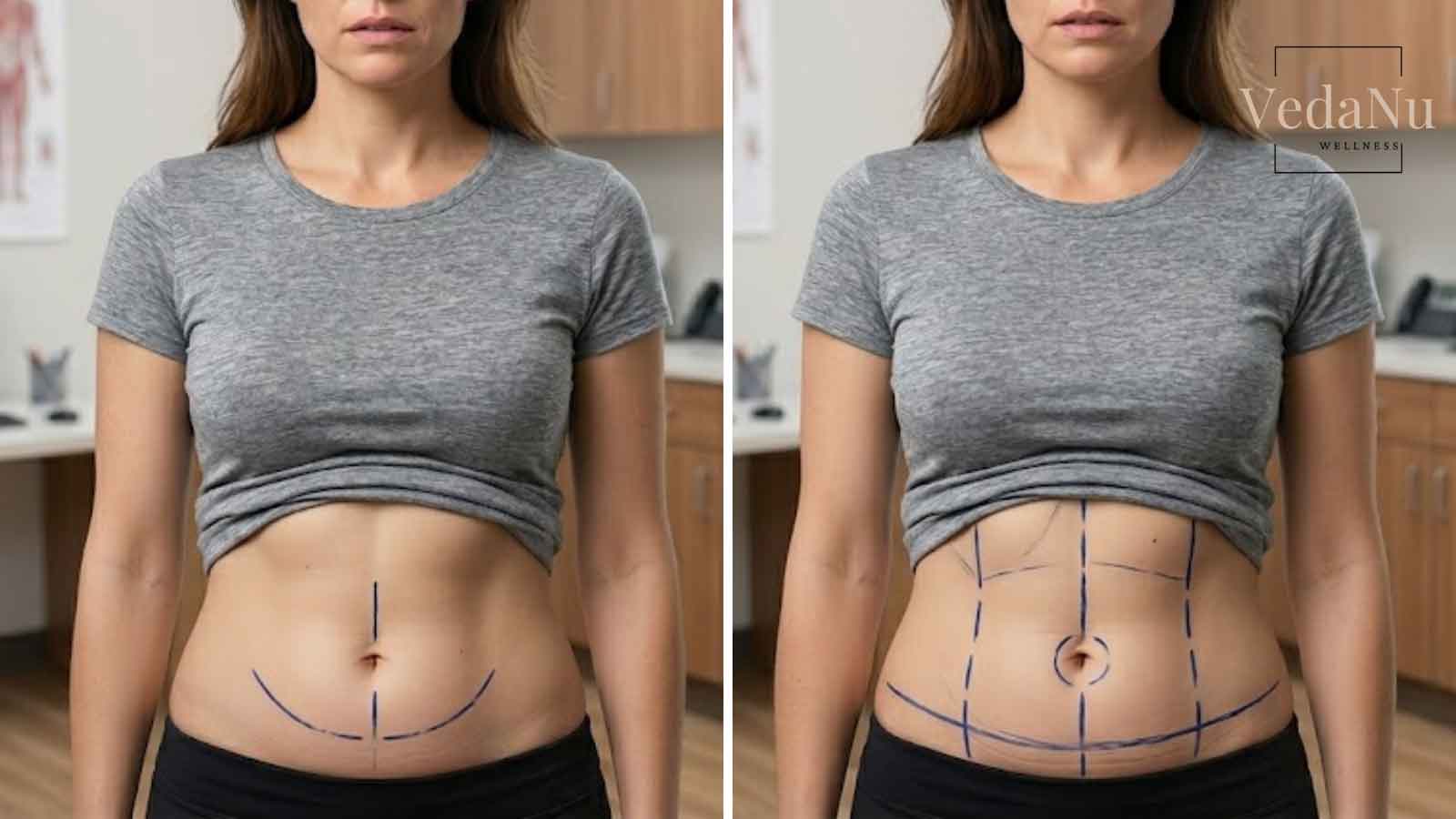
A mini tummy tuck is not a smaller version of the same operation. It treats a different zone of the abdomen and accomplishes different surgical goals than a full tummy tuck, which is why the right choice for one patient is often the wrong one for another.
This guide covers what each body contouring procedure does, who actually qualifies, what to expect during recovery, and how to weigh the trade-offs honestly without leaning toward the bigger surgery or the smaller one.
What Each Procedure Treats At a Glance
The two operations differ across nearly every clinical category. Use the table below as your reference point for the rest of this guide.
| Factor | Mini Tummy Tuck | Full Tummy Tuck |
| Treatment area | Below the belly button only | Ribcage to pubic bone |
| Skin removal | Small lower-abdomen envelope | Full abdominal skin envelope (the layer of skin covering the abdominal area) |
| Muscle repair | Limited; not the standard approach for full diastasis recti (separation of the abdominal muscles along the midline) | Full plication (suturing the separated abdominal muscles back together along the midline) |
| Belly button | Stays in place in most cases | Repositioned to suit the new contour |
| Incision | Short, low, above the pubic line | Hip-to-hip, low-placed, plus a small scar around the navel |
| Surgery time | Typically shorter than a full procedure | Roughly 2 to 3 hours |
| Recovery downtime | Shorter rest period, faster return to light activity | Rest for 1 to 2 weeks, light activity for around 3 to 4 weeks |
| Best fit | Stable weight, localized lower-abdominal concern, no significant muscle separation | Post-pregnancy or post-weight-loss laxity, diastasis recti, and broader skin concerns |
How Each Surgery Is Performed
The mechanics matter more than the marketing. A mini and a full work on different tissue planes, and that is why a patient evaluated for one is rarely a candidate for the other.
The Mini Procedure
The surgeon places a short incision low on the pubic line, lifts a smaller skin flap off the lower abdomen, trims excess tissue, and closes the incision. Muscle work in a mini, when performed at all, is typically limited to the lower abdominal region and depends heavily on the surgeon and the patient’s anatomy. A mini is not the standard fix for diastasis recti, since true muscle separation usually extends above the belly button and cannot be reached without lifting the upper skin flap.
The Full Procedure
The surgeon lifts the entire abdominal skin envelope to expose the full abdominal wall. This allows muscle repair, called plication, to run from the lower ribs down to the pubic bone, which is why a full is the standard approach for post-pregnancy diastasis recti. Excess skin is removed, and a new opening is made in the redraped skin to reveal the existing navel in its natural position.
Where Liposuction Fits In
Both procedures can be paired with liposuction, and the combination is common among patients undergoing a full tummy tuck. Lipo refines the flanks, hips, or upper-abdominal contour that a tummy tuck on its own does not address, and it often plays a larger role in waistline definition than the muscle plication itself.
Many patients benefit from combined procedures, such as a mommy makeover, in which multiple contouring and restorative surgeries are performed in a single operative plan to achieve more comprehensive body shaping and improve overall proportions in a single recovery period.
If a defined waist is one of your goals, ask your surgeon directly how much of that result will come from skin removal, plication, or liposuction. The answer varies patient to patient.
Who Each Procedure Is Built For
Candidacy is the part that most patients self-misdiagnose. Mirror checks at home rarely capture muscle separation or upper abdominal laxity, so the markers below provide a more reliable read.
Mini Tummy Tuck Candidates
A mini tummy tuck typically suits patients with:
- Mild to moderate skin laxity confined to the lower abdomen
- Stable weight at or near goal weight
- Minimal upper-abdominal looseness
- No significant diastasis recti
- A BMI within a healthy range, since elevated BMI raises both surgical risk and the chance of residual laxity
A right-fit mini patient often has a localized concern, such as a small post-cesarean shelf or a stretched lower belly, with the rest of the midsection already close to its desired shape. Choosing a mini in that scenario avoids unnecessary surgery, longer recovery, and a more visible scar.
Full Tummy Tuck Candidates
A full tummy tuck typically suits patients with:
- Loose skin extending above the belly button or wrapping toward the flanks
- Diastasis recti from pregnancy or significant weight changes
- A persistent abdominal pooch that holds after weight stabilization
- Multiple pregnancies or a substantial weight loss history
- Pre-existing cesarean scars combined with overhanging skin
A patient who picks a mini when they need a full often ends up considering a tummy tuck revision surgery later. A patient who picks a full when a mini would have been enough takes on a larger recovery and a longer scar than their anatomy required. Both mistakes are real, and a thorough evaluation is what prevents them.
Outcomes and Realistic Expectations
Each procedure produces a different category of result. Knowing what to expect prevents disappointment after a recovery that already takes months to settle.
After a Mini Tummy Tuck
A mini tummy tuck produces a smoother, flatter lower abdomen with an incision designed to sit beneath most underwear and swimwear. Patients with a focused lower-belly concern often see exactly the result they wanted. The upper abdomen is unchanged, so any pre-existing laxity above the navel will still be visible after surgery.
After a Full Tummy Tuck
A full tummy tuck delivers a flatter, more toned midsection, and in patients with significant diastasis recti, it can meaningfully repair the core muscle wall. Some patients report improved core support and posture after recovery, though these outcomes are not guaranteed and depend on the degree of muscle separation repaired. Waistline definition is influenced by the amount of skin removed, the plication technique, and the extent of any added liposuction.
Neither procedure is a weight loss tool. Long-term results in either case depend on stable weight and consistent habits after surgery.
Read More: Tummy Tuck vs. Liposuction: Which Procedure Is Right for You?
When Will You See the Final Result?
Initial swelling resolves over the first several weeks for both procedures. The final contour usually takes three to six months to settle, sometimes longer in patients with denser tissue or those who have had extensive liposuction. Photos at six weeks are not your final result, and patience during the swelling phase prevents premature concerns about the outcome.
Scarring and Incision Patterns
Both procedures leave a scar. Where it sits and how long it runs differ in ways that matter for swimwear, underwear, and daily comfort.
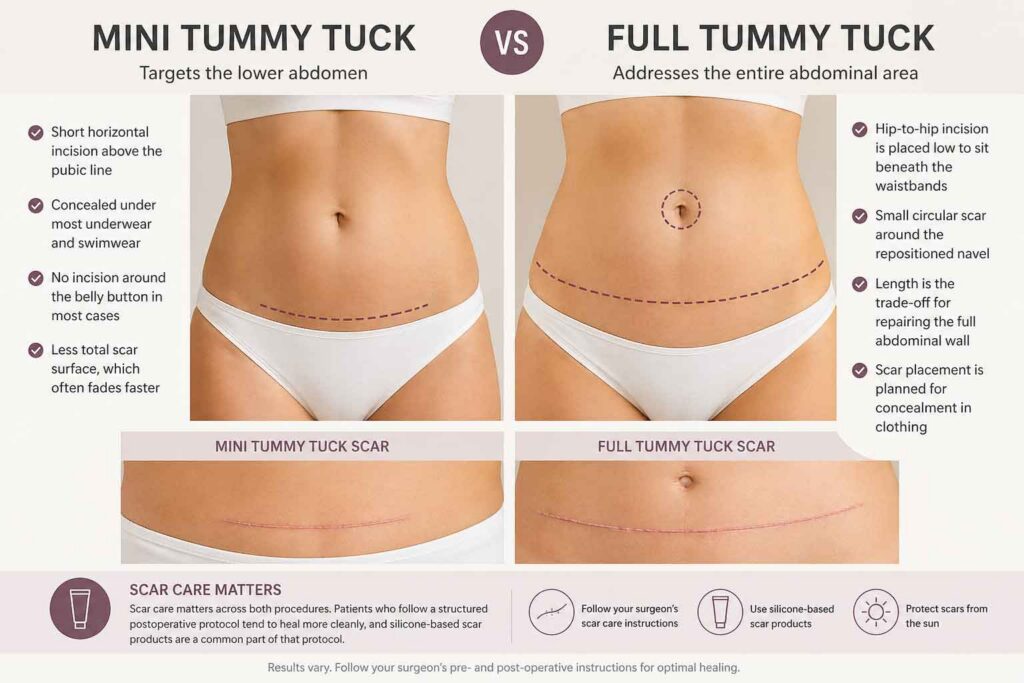
Mini Tummy Tuck Scar
- Short horizontal incision above the pubic line
- Conceals under most underwear and swimwear
- No incision around the belly button in most cases
- Less total scar surface, which often fades faster
Full Tummy Tuck Scar
- Hip-to-hip incision is placed low to sit beneath the waistbands
- Small circular scar around the repositioned navel
- Length is the trade-off for repairing the full abdominal wall
- Scar placement is planned for concealment in clothing
Post-op scar treatment matters across both procedures. Patients who follow a structured postoperative protocol tend to heal more cleanly, and silicone-based scar products are a common part of that protocol.
Recovery, Drains, and Daily Life
Recovery timelines vary by procedure, but the day-to-day experience hinges on more than just the length of downtime. Drain technique and the scope of surgery shape what the first weeks actually look like.
Drain vs. Drainless Techniques
Some surgeons use surgical drains after a tummy tuck to manage fluid buildup, particularly after a full procedure. Others use a drainless technique that relies on internal sutures (called progressive tension sutures) to close dead space (the gap between tissue layers where fluid can collect after surgery) and reduce fluid accumulation without external drains.
Both approaches are accepted, and the right choice depends on the surgeon’s training, the procedure performed, and the patient’s anatomy. Ask your surgeon during the consultation which technique they use and why.
Mini Tummy Tuck Recovery
Most patients return to light activity within one to two weeks. Swelling resolves more quickly than after a full procedure, and core-heavy training stays off the schedule for several weeks even when daily life feels normal. Desk work and short errands often resume earlier in the recovery window.
Full Tummy Tuck Recovery
Most patients rest for the first one to two weeks, with light activity resuming around three to four weeks. Lifting restrictions extend for roughly six to eight weeks to protect the muscle repair. Compression garments are worn for several weeks, and full exercise plus core training requires medical clearance. A structured recovery plan covers staged milestones such as driving, returning to work, and resuming exercise.
Read More: Tummy Tuck Recovery: Week-by-Week Guide
Risks, Revision Rates, and Safety
Every surgery carries risk. Knowing the baseline lets you weigh the trade-offs honestly before committing to a date.
Risks Common to Both
- Infection
- Scarring variations, including hypertrophic or keloid scarring (raised, thickened scars)
- Fluid buildup, called seroma
- Changes in skin sensation
- Wound healing delays
- Bleeding or hematoma
Higher-Exposure Risks With a Full
A full tummy tuck involves longer surgery time and broader tissue work, which increases exposure to risks such as blood clots, prolonged swelling, and wound healing complications. Pre-operative health checks confirm a patient’s readiness for the larger procedure. Elevated BMI, smoking, uncontrolled diabetes, and certain medications raise risk for either procedure, but more sharply for a full.
Revision Considerations
Revision tummy tuck is most often pursued for residual laxity, scar concerns (height, width, or asymmetry), dog-ear puckering at the incision ends, or unnatural belly button placement. Discussing these possibilities during your consultation helps set clear expectations for what a revision would involve if one became necessary.
How Much Does a Tummy Tuck Cost?
A mini tummy tuck typically costs less than a full procedure, given the shorter operative time and simpler recovery. That makes it a reasonable choice when anatomy matches, and it avoids the overtreatment trap of paying more for surgery the patient does not actually need.
A full procedure costs more upfront and delivers broader correction when anatomy calls for it. The honest cost question is not which procedure is cheaper, but which one matches the body in front of the surgeon. Pricing varies by anatomy, surgical plan, and any add-ons such as liposuction, so a custom quote during consultation is the only reliable way to compare. Ask about available financing options during your initial consultation at VedaNu Wellness.
How to Decide Between A Mini or A Full Tummy Tuck
Three honest questions sharpen the decision before consultation. None of them have right or wrong answers, but each one moves you closer to the procedure that actually fits.
Anatomy You Cannot Self-Diagnose
Diastasis recti is felt under the hand, not seen. Upper-abdominal laxity often hides under bracing or posture, and a small lower-belly shelf can sit on top of muscle separation that patients do not realize they have. A surgeon’s exam catches what self-assessment misses.
What You Want a Year From Now
Patients often answer outcome questions by listing what they don’t like today. Flip the question: when you imagine your body twelve months after surgery, what is different? A clear answer points more honestly toward the right procedure than a list of complaints does, and it helps your surgeon calibrate which trade-offs are worth it for you.
Your Lifestyle and Recovery Capacity
Time off work, household help during the first weeks, and the ability to avoid lifting all influence which procedure is realistic in your current life. Some patients delay surgery until those conditions are in place rather than choose a smaller procedure for the wrong reasons.
A thorough consultation goes beyond surface impressions. Measurements, photos, and full medical history give your surgeon the information needed to recommend the procedure that fits your body, not the procedure that fits a search query.
Take the Next Step at VedaNu Wellness
If you are weighing a full tummy tuck against a mini and want a clear recommendation grounded in your anatomy and goals, schedule a consultation with board-certified plastic surgeon Dr. James Chao, FACS, at VedaNu Wellness. Our team will evaluate your abdominal wall, talk through realistic outcomes, and walk you through what recovery would look like in your life. Contact VedaNu Wellness today to see how we can help you.