
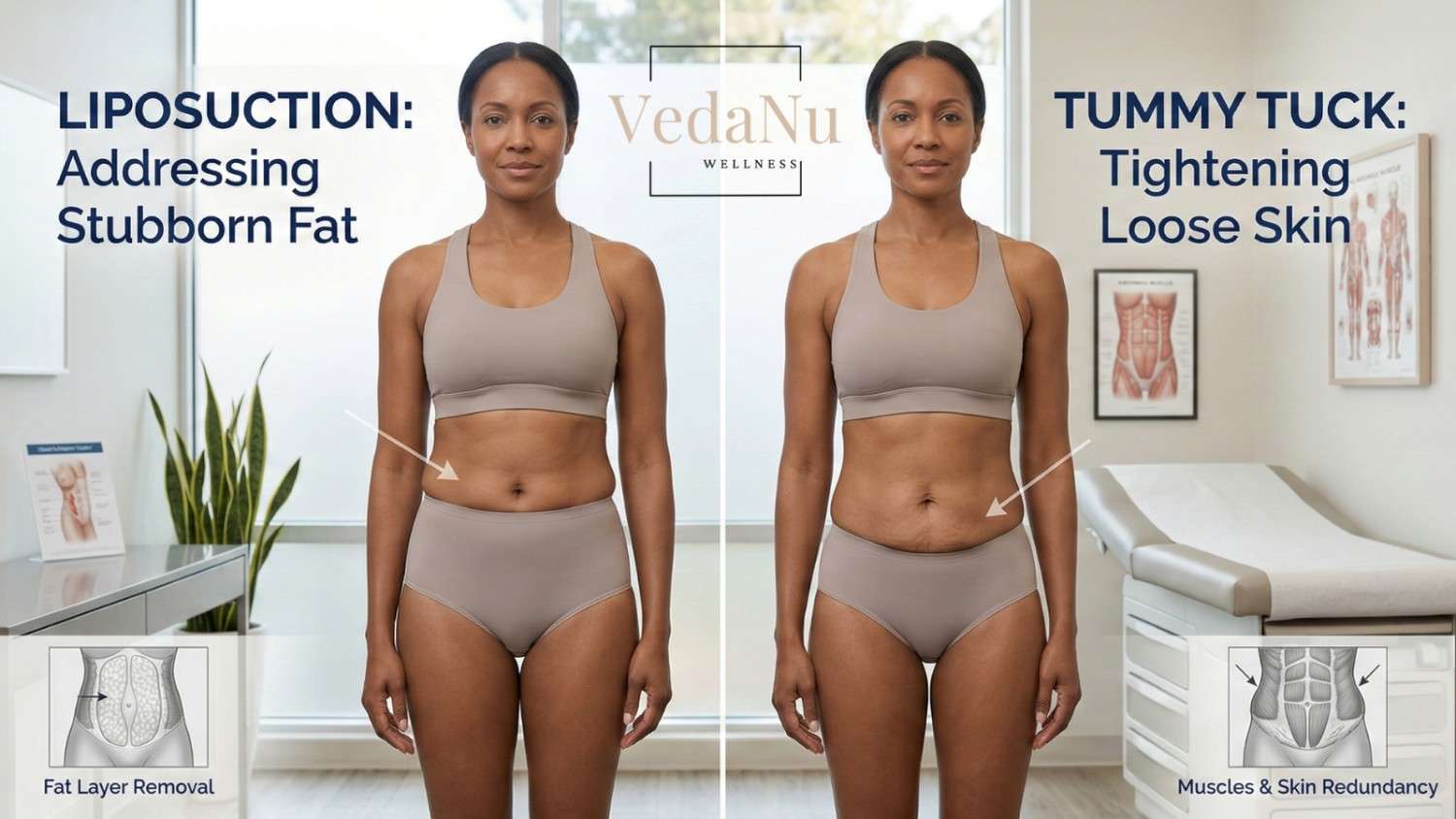
Both a tummy tuck and liposuction can reshape your midsection, but they solve very different problems. One removes stubborn fat. The other removes excess skin and repairs weakened muscles. Choosing the right procedure means your results align with your body’s true needs, your recovery expectations, and your long-term goals.
If you’ve been researching tummy tuck vs. liposuction and feel more confused than when you started, you’re not alone. Social media before-and-after photos rarely explain which procedure was performed, why it was chosen, or what the patient’s body looked like underneath the skin. Deciding between a tummy tuck and liposuction always comes down to three factors: your skin elasticity, the condition of your abdominal muscles, and how much fat versus loose skin you’re dealing with.
What Each Procedure Actually Does
These two procedures are not interchangeable. Understanding how each one works will help you ask sharper questions and feel more confident when you sit down with your surgeon.
How Liposuction Works
Liposuction targets localized fat deposits that resist diet and exercise. At VedaNu Wellness, liposuction is performed using the tumescent technique, which involves injecting a solution that numbs the treatment area, reduces bleeding, and loosens fat for easier removal. Your surgeon then makes small incisions and inserts a thin tube called a cannula to break up and suction out fat cells.
The procedure typically takes one to two hours. The fat cells removed do not grow back. That said, remaining fat cells in untreated areas can still expand if you gain a significant amount of weight after surgery, so maintaining a stable weight protects your results long-term.
What liposuction does not do is just as important. It will not tighten loose or sagging skin, nor will it repair separated abdominal muscles, a condition known as diastasis recti. Your skin needs enough natural elasticity to contract on its own once the underlying fat is gone.
If your skin lacks that recoil, liposuction alone may leave you with a slimmer layer underneath but the same loose, hanging skin you started with. This is a body contouring and sculpting tool, not a skin-tightening procedure.
How a Tummy Tuck Works
A tummy tuck, known medically as an abdominoplasty, addresses what liposuction cannot. Your surgeon makes a longer incision along the lower abdomen, typically hip to hip, then removes the excess skin and tightens the underlying tissue.
If your abdominal wall muscles have separated (a very common occurrence after pregnancy or major weight loss), the surgeon sutures them back together in a step called muscle repair. This restores structural support to the abdominal wall and can improve core stability over time. The navel is repositioned during the procedure, and you will be under general anesthesia for two to three hours.
A tummy tuck resolves specific conditions:
- Stretched skin with poor elasticity
- Weakened or separated abdominal wall muscles
- Stretch marks on the lower abdomen
The result is a firmer, flatter midsection with renewed structural integrity.
Who Is the Right Candidate for Each
The right procedure depends on what your body needs right now, not what worked for someone you follow online.
When Liposuction May Be the Better Fit
Liposuction tends to be the stronger option if you have:
- Good skin elasticity, meaning your skin springs back when pinched rather than staying folded
- Isolated fat pockets in the abdomen, flanks, or love handles that persist even with a healthy lifestyle
- No significant loose or hanging skin around your midsection
- Intact abdominal muscles with no separation
- A body weight within approximately 30 pounds of your goal, with localized trouble spots as the primary concern
This profile is common among patients with mild-to-moderate post-weight-loss changes and among men with stubborn abdominal and flank fat. Liposuction works best when your skin still has enough elasticity to contract after fat removal. Non-smokers tend to heal faster and experience fewer complications, and active smoking may disqualify you from candidacy.
When a Tummy Tuck Is the Stronger Choice
An abdominoplasty is typically the better path if you are experiencing:
- Significant loose or hanging skin around the midsection that bunches or folds when you bend
- Visible stretch marks that are concentrated on the lower abdominal skin
- Separated abdominal muscles (diastasis recti), which creates a belly that protrudes even at a healthy weight
- A midsection shape that healthy eating, regular workouts, and weight loss have not been able to correct
- Prior C-section or abdominal surgery that left you with excess scar tissue and skin laxity
This profile is especially common among post-pregnancy patients and individuals who have lost 50 or more pounds. If you smoke, you will need to stop at least four weeks before surgery to support proper healing. If your concerns extend beyond the front of your abdomen to the flanks and hips, you may be a candidate for an extended tummy tuck that covers a wider area.
Recovery and Downtime Compared
Recovery timelines play a major role in deciding between lipo vs. tummy tuck. When you compare liposuction vs. tummy tuck recovery side by side, the gap in downtime is significant enough to affect your work schedule, childcare arrangements, and daily routine.
What to Expect After Liposuction
Here is what your liposuction recovery timeline looks like:
- Compression garments: Worn for several weeks to support healing and reduce swelling
- Light activity: Short walks can start within the first 24 hours
- Return to work: Most patients are back at a desk within two to seven days
- Strenuous exercise: Your surgeon will clear you after at least two weeks, depending on the extent of your procedure
- Swelling: Peaks during the first week and fades gradually over the following months
- Final results: Your body contouring results become visible around three to six months post-surgery
Bruising and temporary numbness in the treated areas are normal and resolve on their own.
What to Expect After a Tummy Tuck
Tummy tuck recovery requires more patience and planning. Here is what to expect:
- Surgical drains: May be placed near the incision site and are typically removed within two to four weeks
- Compression garment: Worn for two to four weeks to reduce swelling and support your new contour
- Return to work: Most patients take two to four weeks off. Physically demanding jobs may require a longer absence.
- Lifting and bending: Restricted for six to eight weeks to protect the muscle repair and allow internal tissues to heal
- Incision placement: Sits along the lower abdomen, positioned beneath a standard bikini line
- Scar maturation: Scars fade significantly over 12 to 18 months with proper care
VedaNu Wellness offers post-op scar treatment protocols to support your healing and minimize scar visibility. If your concerns are limited to the area below the navel, a mini tummy tuck involves a shorter incision and a faster recovery timeline.
Can You Combine a Tummy Tuck and Liposuction?
Yes. If you need both fat removal and skin tightening, Dr. Chao can perform liposuction on the flanks, upper abdomen, or back during the same session as your abdominoplasty, giving you more comprehensive body contouring in one procedure rather than two separate surgeries weeks or months apart. This combined approach is a core part of the Mommy Makeover at VedaNu Wellness, and patients considering a Brazilian Butt Lift may be able to use fat harvested during liposuction for the transfer.
Dr. Chao will assess your anatomy during your appointment and tell you exactly what the combined tummy tuck and liposuction procedure involves, how long it will take, and what your recovery will look like.
Tummy Tuck vs. Liposuction At A Glance
For a fast reference, here is how abdominoplasty vs. liposuction compares across the factors that matter most:
| Factor | Liposuction | Tummy Tuck |
| Primary Goal | Remove stubborn fat deposits | Remove excess skin + repair muscles |
| Addresses Loose Skin | No | Yes |
| Repairs Separated Muscles | No | Yes (diastasis recti) |
| Anesthesia | Local, IV sedation, or general | General |
| Procedure Time | 1-2 hours | 2-3 hours |
| Return to Work | 2-7 days | 2-4 weeks |
| Full Results Visible | 3-6 months | 6-12 months |
| Scarring | Small, minimal | Longer incision (bikini line) |
| Can Be Combined? | Yes | Yes |
If You’re Still Unsure

Not every decision fits neatly into a checklist. Here is the simplest way to think about it:
- If your main concern is stubborn fat and your skin is firm, liposuction is likely your best fit.
- If your main concern is loose, sagging skin or a protruding belly due to muscle separation, a tummy tuck will address what liposuction cannot.
- If you’re dealing with both, combining the two procedures in one session gives you the most complete result.
The only reliable way to know which procedure fits your body is a hands-on evaluation. During your consultation with Dr. James Chao at VedaNu Wellness in San Diego, he will evaluate your anatomy and recommend the most effective approach for your specific goals.
You will leave with a clear understanding of your options, a personalized surgical plan, and a transparent cost estimate. No pressure. Just expert guidance tailored to your body and what you want to achieve. Contact our clinic to book a consultation.
Frequently Asked Questions
Is liposuction less invasive than a tummy tuck?
Yes. Liposuction uses smaller incisions, shorter operating times, and local anesthesia. Recovery is faster, and most patients return to normal activity within the first week. A tummy tuck is a more involved surgery that includes skin removal, muscle repair, and a longer incision, which means a longer recovery as well.
Can liposuction fix a hanging belly?
No. Liposuction removes fat but does not address loose or hanging skin. If your belly hangs or folds when you bend forward, you likely need a tummy tuck to remove that excess skin and tighten the abdominal wall.
Will a tummy tuck remove stretch marks?
A tummy tuck removes stretch marks on the skin excised during surgery, typically the skin below the navel. Stretch marks above the belly button will remain, though they may shift lower and become less visible as the skin is pulled taut.
Which procedure has more downtime?
A tummy tuck requires significantly more downtime. Most patients take 2 to 4 weeks off work, and heavy lifting is restricted for 6 to 8 weeks. Liposuction patients typically return to desk work within 2 to 7 days and resume strenuous activity after at least 2 weeks.
How long do results last?
Both procedures deliver long-lasting results when you maintain a stable weight. The fat cells removed during liposuction do not return, and the skin removed during a tummy tuck will not grow back. Significant weight fluctuations, pregnancy, or aging can affect your results over time, so a stable lifestyle is key.
Read More: How to Maintain Results After Losing Weight
Is one procedure safer than the other?
Both procedures carry risks that are minimized when performed by a board-certified plastic surgeon in an accredited facility. A tummy tuck carries a slightly higher surgical risk. It is a more involved procedure with a larger incision and longer anesthesia time. Dr. Chao discusses all risks and safety protocols with you during your consultation.
Is a tummy tuck less expensive than liposuction?
A tummy tuck typically costs more than liposuction because it is a more extensive operation. Liposuction focuses on removing localized fat through small incisions, making it less invasive and generally less complex. In contrast, a tummy tuck involves removing excess skin, tightening weakened or separated abdominal muscles, and reshaping the entire midsection. The added surgical time, muscle repair, and broader scope of correction are why a tummy tuck usually carries a higher price point.
Our plastic surgery clinic in San Diego offers financing options to make body contouring accessible to more patients. You will receive a personalized quote with a detailed cost breakdown after Dr. Chao evaluates your anatomy and discusses your goals.