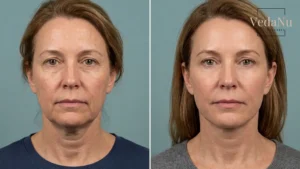
If your face looks thinner or less defined than it used to, a facelift alone may not address everything you see in the mirror. As you age, your cheeks may lose fullness, your temples may appear hollow, and deeper shadows can form beneath your eyes. A facelift can lift and reposition tissue that has shifted with age, but it cannot restore lost facial volume on its own. If you’re considering a facelift in San Diego, combining it with fat transfer may help create a fuller, more balanced appearance without relying on tightening alone.
At VedaNu Wellness, board-certified plastic surgeon Dr. James Chao offers personalized surgical care that considers both facial aging and your desired appearance.
How Descent and Deflation Change Your Face With Age
Your face changes in two main ways as you age. Descent happens when your skin and underlying tissues gradually shift downward, and deflation occurs when your face loses its natural fullness. You may notice a less defined jawline, flatter cheeks, or deeper shadows beneath your eyes. Although these changes often appear together, each affects your appearance differently and may require a different treatment.
Descent Causes Sagging Along Your Jawline and Neck
As you age, your skin loses collagen and elasticity, and the deeper tissues that support your face gradually shift downward. The Superficial Musculoaponeurotic System (SMAS), a layer of tissue beneath your skin, also plays an important role in supporting your facial contours.
These changes can lead to:
- Jowls: Sagging tissue makes your jawline look less defined.
- Deeper facial folds: Lines between your nose and mouth become more noticeable.
- Loose neck skin: Sagging skin and changes in the underlying neck muscles can create visible folds or bands.
Facelift surgery addresses these concerns by lifting and repositioning underlying facial tissues and removing excess skin when needed.
Deflation Creates Hollow Areas and Flatter Facial Contours
Your face also loses volume as the fat beneath your skin changes and your facial bones gradually lose some of their structure. You may notice these changes even when your skin still feels relatively firm.
Common areas of volume loss include:
- Temples: You may develop hollow areas along the sides of your forehead.
- Cheeks: Your midface may look flatter as it loses its natural fullness.
- Under-eyes: Volume loss can make the grooves beneath your eyes more noticeable.
- Around the mouth: Reduced facial fullness can make lines and creases appear deeper.
Hormonal changes during menopause and significant weight loss can make facial volume loss more noticeable. Weight loss associated with GLP-1 medications, including semaglutide and tirzepatide, may also reveal these changes, particularly when weight drops quickly. These facial changes relate to weight loss rather than a unique fat-damaging effect of the medications.
What Can a Facelift Correct, and What Does It Leave Behind?
A facelift can improve skin laxity and restore definition to your facial contours, but it cannot replace the volume you’ve lost over time. You may notice a smoother jawline and firmer neck after surgery, yet your cheeks or temples may still appear hollow. Understanding what a facelift can and cannot address helps you understand what your results may look like.
A Facelift Lifts Sagging Tissue and Defines Your Jawline
A facelift (rhytidectomy) repositions underlying facial tissues and removes excess skin to improve visible signs of aging. Dr. Chao considers the degree of jowling, neck laxity, and location of sagging tissues when selecting a surgical technique.
Common surgical approaches include:
- SMAS facelift: Lifts and repositions the supportive tissue beneath your skin to improve your lower face and jawline.
- Deep plane facelift: Releases specific facial ligaments and repositions deeper tissues to address sagging in your cheeks, jawline, and lower face.
- Endoscopic techniques: Small incisions and a thin camera allow Dr. Chao to reposition tissues in selected areas, most commonly the brow and upper face. These techniques can complement a lower-face lift, but they do not replace one.
Each technique addresses different concerns, and the improvements depend on the areas treated. Even when a surgeon successfully lifts sagging tissues, the procedure does not directly replace facial fat lost through aging.
How Does Fat Transfer Restore Volume That a Facelift Cannot?
Facial fat transfer, also known as facial fat grafting, uses fat from your own body to restore fullness in selected areas of your face. The grafting process involves collecting, preparing, and carefully placing the fat beneath your skin to improve volume and facial contours.
The transferred fat needs to establish a blood supply in its new location to survive. The amount of fat that remains depends on several factors, including the surgical technique and condition of the surrounding tissues.
Your Surgeon Collects, Processes and Transfers Your Own Fat
Facial fat transfer involves three main steps:
- Harvesting: Gentle liposuction collects a small amount of fat from your abdomen, flanks, or thighs.
- Processing: The surgical team prepares the collected fat by separating it from excess fluid and other unwanted material.
- Placement: Thin tubes called cannulas deliver small, carefully measured amounts of fat into targeted facial areas.
Distributing the fat in small amounts across appropriate tissue layers supports blood supply development and improves graft survival. Since the procedure uses your own tissue, allergic reactions are uncommon.
The amount of fat Dr. Chao transfers depends on your facial proportions, available donor fat, and the degree of volume correction needed. Careful placement matters because adding too much fat can create unwanted fullness or uneven contours.
Where Can Fat Transfer Add Fullness?
Dr. Chao identifies areas that may benefit from fat grafting and determines how much volume each area needs.
Common treatment areas include:
- Temples: Carefully placed fat may restore fullness and improve the transition from your temples toward your cheekbones.
- Mid Cheeks: Fat grafting can add volume to the central cheeks and improve the contour between your cheekbones and lower face.
- Tear troughs: Small amounts of fat may soften the transition between your lower eyelids and cheeks. A refined technique called microfat grafting uses smaller fat particles suited to this thin, delicate area.
- Around the nose and mouth: Targeted grafting may soften selected facial folds and restore fullness around the mouth.
Not every area requires fat transfer, and delicate regions such as the under-eyes need careful assessment because of their anatomy and potential complications.
Why Combining a Facelift With Fat Transfer Looks More Natural
Natural-looking facial rejuvenation depends on more than lifting skin or adding fat. The position of your underlying tissues, distribution of facial volume, and relationship between your features all influence the final appearance.
A well-planned combined procedure considers these factors so that changes in one area complement the rest of your face.
Careful Tissue Repositioning Helps Avoid an Overly Tight Look
A facelift should reposition the tissues that have shifted with age rather than rely on pulling your skin tightly. Excessive skin tension can create an unnatural appearance and place unnecessary stress on surgical incisions.
A deep plane facelift addresses deeper facial structures, allowing Dr. Chao to reposition descended tissues while limiting reliance on skin tension.
Fat grafting serves a separate purpose. It can complement the lift by adding volume where your face needs additional fullness, but it does not replace proper tissue repositioning or prevent excessive skin tension on its own.
Strategic Fat Placement Helps Preserve Your Facial Features
The amount and location of transferred fat can influence how your facial features look after surgery. Adding too much volume or placing it in unsuitable areas may create uneven contours or change your natural proportions.
Your treatment plan maps how different facial areas relate to one another before grafting begins. Conservative placement may help improve selected hollows without making your face appear excessively full.
The goal is to create smooth transitions between your facial features while maintaining your recognizable appearance. This requires careful planning rather than adding the same amount of fat to every treatment area.
Who Is a Good Candidate for a Facelift With Fat Transfer?
Combining a facelift with fat transfer may be appropriate when descent and deflation affect your face at the same time. Your facial anatomy, overall health, and aesthetic goals help determine your candidacy.
As you age, you may notice changes in your facial shape that go beyond loose skin. Comparing your current appearance with older photos can help you recognize where your face has lost definition or volume.
You may benefit from both procedures if you notice:
- Descent and deflation together: The jowls and neck laxity described above appear alongside flatter cheeks or hollow temples and under-eyes.
- Weight or hormonal changes: Significant weight loss or menopause has left your face looking thinner or less defined.
Physical appearance alone does not determine if combined surgery is appropriate. Dr. Chao also considers several medical factors:
- Overall health: Certain medical conditions can increase surgical or healing risks.
- Smoking and nicotine use: Nicotine can interfere with blood flow and wound healing.
- Weight stability: Maintaining a stable weight, especially after significant weight loss, can support more predictable long-term results.
- Available donor fat: The grafting procedure requires a suitable amount of donor fat.
- Realistic expectations: You should understand that some transferred fat may not survive and that individual results vary.
If you have both sagging and volume loss, Dr. Chao can assess if treating them during the same operation is appropriate for your health and goals.
When a Facelift or Volume Restoration Alone May Be Enough
You may not need combined surgery if your concerns mainly involve sagging or volume loss.
- Facelift alone: You have noticeable jowls or loose skin around your jawline and neck, but your cheeks and temples still have adequate fullness.
- Fat transfer alone: Your skin remains relatively firm, but volume loss makes your face appear thinner. Fat grafting may restore fullness without additional lifting.
- Combined facelift and fat transfer: You have significant tissue descent and facial volume loss that may benefit from surgical correction during the same operation.
- Non-surgical volume restoration: If you have mild volume loss without significant sagging, dermal fillers or Sculptra may offer an alternative.
Dermal fillers typically provide temporary volume correction using injectable materials. Sculptra stimulates collagen production over time, whereas fat grafting transfers your own tissue and requires a surgical procedure. Each option has different risks, recovery needs, and maintenance considerations.
During a surgical evaluation, your plastic surgeon at VedaNu Wellness reviews your medical history, skin elasticity, facial structure, and treatment goals to determine which approach may be appropriate.
What Should You Expect From Facelift With Fat Transfer Results, Recovery and Cost?
If you’re planning a facelift in San Diego with fat transfer, prepare for both facial healing and care of the donor area that supplies the fat. Your recovery timeline, long-term volume retention, and surgical expenses will depend on the extent of treatment.
How Long Can Fat Transfer Results Last?
Fat transfer can provide long-lasting volume restoration, but not all transferred fat survives. Your body naturally absorbs some of the grafted fat as the treated areas heal. The amount that remains varies based on your anatomy, the surgical technique, and other individual factors.
Here’s what you can generally expect:
- First 3 to 6 months: Some transferred fat does not establish an adequate blood supply and is gradually absorbed as the graft stabilizes.
- Long-term results: Fat that establishes a healthy blood supply can remain in place for years.
- Future changes: Natural aging and weight fluctuations can affect your facial volume.
As your results settle, certain areas may retain more fullness than others. If noticeable volume loss or unevenness remains, Dr. Chao may recommend an additional fat grafting session. Not every patient needs a touch-up, though.
Maintaining a stable weight can help preserve your results because transferred fat responds to weight changes like fat elsewhere in your body.
What Is Recovery Like After Combining Both Procedures?
Your recovery will largely follow the healing process of facelift surgery, with additional swelling and temporary discomfort from fat grafting. Since fat grafting involves collecting fat from another area of your body, you’ll need to care for both your face and the donor site.
Common recovery experiences include:
- Facial swelling: Your cheeks and under-eye areas may appear fuller during the first few weeks as swelling gradually decreases.
- Donor-site discomfort: You may experience temporary bruising, swelling, or soreness in the area that supplied the fat.
- Changes in facial appearance: Your face may initially look fuller than expected, with its contours becoming easier to assess as swelling resolves.
Many patients can return to desk work within approximately 10 to 14 days, although your recovery may take longer depending on the extent of surgery. Residual swelling can last for several months, and your final facial contours may take around six months or longer to become apparent.
Dr. Chao may recommend avoiding pressure on grafted areas, limiting strenuous activity, and following specific instructions for donor-site care. These precautions depend on your procedure and healing progress.
Allow enough recovery time before important events or travel, and follow Dr. Chao’s post-operative instructions.
How Does Fat Transfer Affect Your Facelift Cost?
Combining fat transfer with a facelift generally increases your total facelift cost because Dr. Chao performs additional steps to collect, prepare, and inject fat.
Several factors influence your surgical estimate:
- Facelift technique: The surgical approach and complexity of your procedure affect the overall cost.
- Treatment areas: The number of facial areas receiving fat grafting can influence surgical time.
- Anesthesia and facility fees: Your estimate accounts for the anesthesia services and surgical facility required for your treatment.
- Additional surgical work: Fat harvesting, processing, and placement add to the procedure’s complexity.
Combining both procedures may allow you to complete treatment under one anesthesia session rather than scheduling separate operations. The additional surgical work can still increase the overall expense compared with a facelift alone.
Your final estimate depends on the surgical plan, the complexity of treatment, and the services included in your procedure.
What Are the Risks and Limitations of Facial Fat Grafting?
Facial fat grafting carries potential complications that you should understand before surgery. Although many patients heal without major problems, some experience uneven contours, persistent lumps, or complications involving the transferred fat.
Understanding these risks can help you make informed decisions about your treatment.
Uneven Contours and Other Complications Can Occur
Some patients develop uneven fullness, small lumps, or firm areas beneath the skin after facial fat grafting. These changes may improve with healing, but persistent irregularities can require further assessment or treatment.
Other potential complications include:
- Asymmetry: Differences in fat retention or placement may leave one side of your face fuller than the other.
- Contour irregularities: Fat may create uneven or unwanted fullness in certain areas.
- Fat necrosis (hardened areas where transferred fat did not survive): Fat that fails to establish a blood supply can form firm lumps or areas of inflammation.
- Infection: Bacteria can cause infection at the treatment or donor site.
- Vascular complications: Accidental injection into a blood vessel can cause serious tissue damage. Although extremely rare, vascular events are a known risk of any fat injection procedure, making precise technique and surgeon expertise critical.
Dr. Chao works to reduce these risks through careful patient selection, detailed knowledge of facial anatomy, and precise surgical technique. Using appropriate injection methods and placing small amounts of fat in carefully selected tissue layers can help improve control during grafting.
That said, no surgical technique eliminates every risk. Understanding possible complications and discussing them with a qualified plastic surgeon are important parts of informed consent.
Plan Your Facelift in San Diego at VedaNu Wellness
Your facelift should address the changes you see in your face while preserving your natural features. At VedaNu Wellness, Dr. James Chao, a board-certified plastic surgeon and Fellow of the American College of Surgeons (FACS), brings more than 25 years of experience in plastic, reconstructive, and hand surgery. He develops personalized treatment plans that may include a deep plane facelift, endoscopic techniques, facial fat grafting, or a combination of procedures based on your anatomy and aesthetic goals.
Our San Diego clinic at 8901 Activity Road, Suite 102, San Diego, CA 92126 welcomes patients from La Jolla, Del Mar, Rancho Santa Fe, Carlsbad, Encinitas, Carmel Valley, and surrounding communities. Patients in the Los Angeles area can visit our Beverly Hills clinic at 433 N Camden Drive, Suite 610, Beverly Hills, CA 90210. We also welcome out-of-town patients and can help coordinate consultation and recovery planning for those traveling for treatment. Learn more about our facelift rhytidectomy procedures, facial fat grafting, and facial recovery timeline.
VedaNu Wellness offers financing options through Cherry, CareCredit, and PatientFi to help you plan your surgical expenses. You can also ask our team about available special offers and current promotions. Explore our financing options, call 858-222-2883 or schedule your consultation to discuss your treatment options with our team.
Frequently Asked Questions
How long does fat transfer last after a facelift?
Fat that establishes a blood supply during the first 3 to 6 months can last for years and behaves like the rest of your facial fat. Your face continues to age naturally, so a stable weight and daily sun protection help you maintain both your lift and your restored volume.
Is fat transfer better than fillers with a facelift?
Neither option suits every patient. Fat transfer uses your own tissue and tends to last longer, but it requires a harvest site and adds early swelling. Fillers involve no surgery and are easy to adjust, though they need repeat treatments. Many patients choose fat transfer during their facelift, since they are already in surgery, and use fillers later for fine-tuning.
How much does a facelift with fat transfer cost?
Your cost depends on the facelift technique, the number of areas grafted, anesthesia, and facility fees. Our team provides a detailed estimate after your consultation and can walk you through available financing options.
Can you get fat transfer without a facelift?
Yes. If your skin still has good elasticity and your main concern is volume loss, fat transfer alone may restore fullness. It cannot lift loose skin, so patients with noticeable jowls or neck laxity typically see better results when they pair it with a facelift.