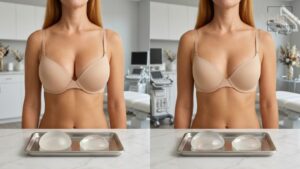
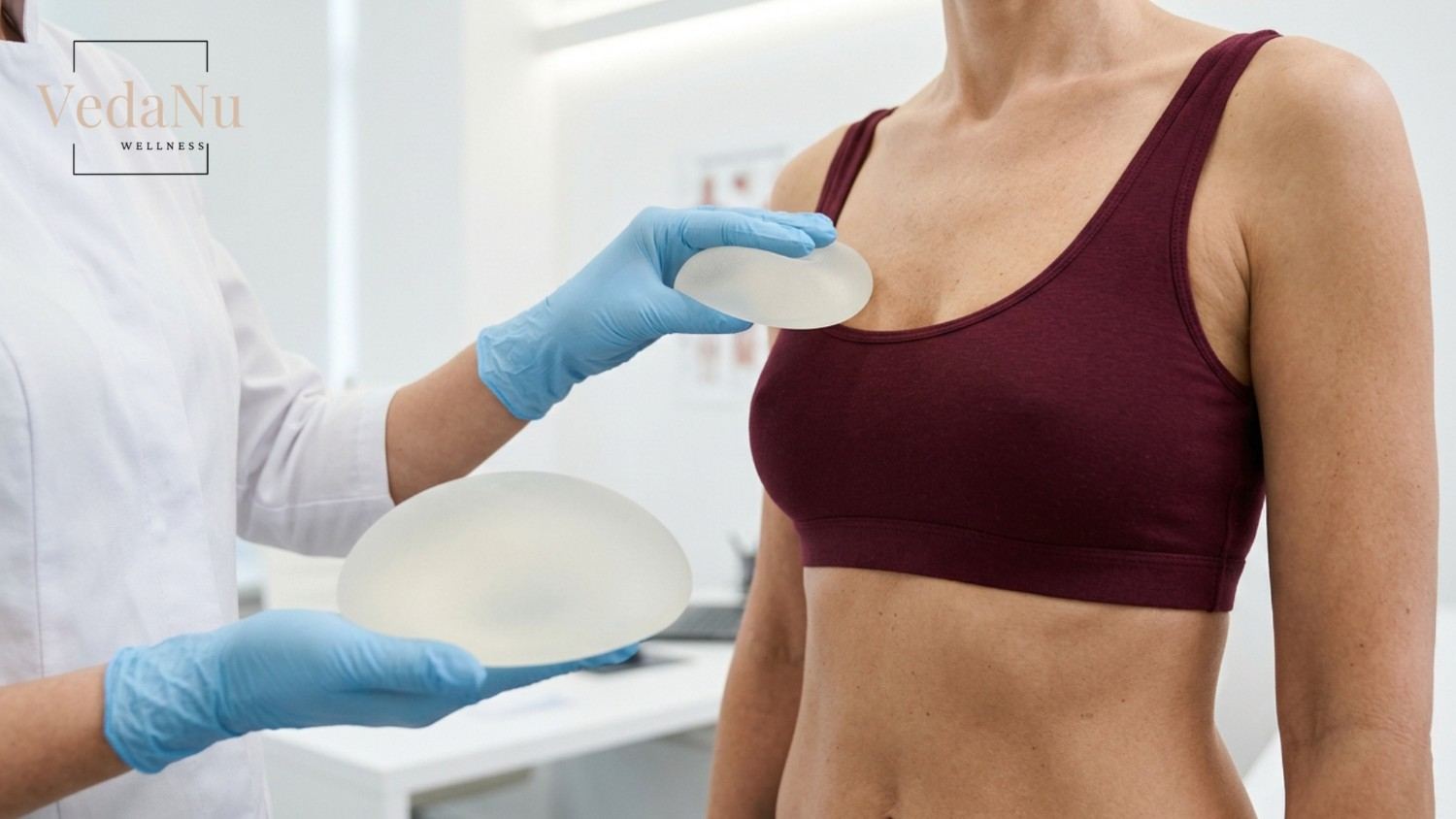
Upgrading to extra large breast implants involves more than choosing a larger size. If you already have breast implants, increasing their volume can affect your breast shape, the space that holds each implant, and how your body supports the added weight.
At VedaNu Wellness, board-certified plastic surgeon Dr. James Chao carefully evaluates your anatomy, existing implants, and aesthetic goals to determine the most appropriate surgical approach. Understanding these factors can help you decide if extra large breast implants in San Diego match your desired appearance and long-term comfort.
Is an XL Upgrade Just an Implant Swap?
No. An XL upgrade involves more than replacing the implants from your earlier breast augmentation with larger ones. The procedure may require changes to the existing implant pocket, the capsule around it, or the surgical approach to accommodate the additional volume.
Why Is This a Breast Revision, Not a Simple Exchange?
Replacing a breast implant with a larger one isn’t as straightforward as removing one device and inserting another. Your body forms a scar tissue capsule around every implant, and that capsule may need to be released, reshaped, or removed to fit the new size. The implant pocket itself may need reconstruction to support a larger volume and keep it positioned correctly. That added work is what makes an upgrade a breast revision rather than a simple exchange.
Your surgeon evaluates the condition of your existing capsule, the position of your current implants, and any changes from your previous surgery. More extensive adjustments may require a longer or additional incision beyond your original scar.
Pocket Adjustments Accommodate Larger Implants
Extra large breast implant surgery may require adjustments to the pocket that holds your existing implants. Depending on your anatomy and the capsule around your implant, your plastic surgeon may recommend:
- Capsulotomy: Opening or releasing the capsule surrounding your implant to adjust the available space.
- Capsulectomy: Removing part or all of the capsule when medically necessary.
- Pocket reconstruction: Reshaping the existing implant pocket to accommodate the new implant and improve its positioning.
Not every revision requires these techniques. The adjustments depend on your current implant placement, capsule condition, and the changes needed to accommodate larger implants.
Some Patients May Need a Staged Approach
If your breast tissue cannot safely accommodate your desired implant size in one procedure, the surgical plan may call for increasing the volume gradually.
A staged approach involves separate procedures that allow time for healing and tissue adjustment between surgeries. In selected cases, tissue expansion may also be considered, although it is not a routine requirement for cosmetic implant upgrades.
Even with gradual increases, your anatomy may limit the final size you can safely achieve.
What Changes in Your Look, Shape, and Support?
Upgrading to larger implants can change your breast fullness, forward projection, and overall silhouette. These changes depend on the implant’s dimensions, material, and how your existing breast tissue responds to the additional volume.
How Implant Profile and Proportions Affect Your Results
Implant volume, base width, and projection work together to determine your breast shape. Base width refers to how much space the implant occupies across your chest, while projection describes how far it extends forward.
High-profile and ultra-high-profile implants generally provide greater forward projection with narrower bases than lower-profile options of similar volume. Ultra-high-profile implants typically create even more projection relative to their width, which can produce a more prominent breast contour.
Two sets of large breast implants with identical volumes can look different depending on your chest dimensions, natural breast tissue, and how the implant sits. A wider implant may create more fullness across the chest, while a narrower implant with greater projection may produce a more pronounced forward shape.
Understanding these differences can help you choose an appearance that complements your proportions and personal preferences.
Larger Implants Place More Stress on Your Tissue
As implant size increases, the added weight places greater pressure on your skin and breast tissue. Over time, this can contribute to stretching, sagging, or the implant shifting, particularly when the surrounding support structures are limited.
Thin breast tissue or reduced skin elasticity can also make implant edges and rippling more noticeable. Rippling occurs when folds or wrinkles in the implant shell become visible or can be felt through the skin.
These concerns do not affect everyone equally. Your existing tissue coverage, implant placement, and skin condition influence how well your breasts accommodate the additional volume. Maintaining a stable weight may help limit further changes in breast shape, although it cannot completely prevent tissue stretching.
Additional Procedures May Improve Support
If your breasts have existing sagging or weakened skin and support structures, your plastic surgeon may recommend additional procedures alongside implant replacement. These techniques address specific concerns rather than serving as routine requirements for every upgrade.
Options may include:
- Breast lift: Removes excess skin and reshapes the breasts when sagging affects their appearance. A lift may also reposition the nipples when necessary.
- Internal support: Uses selected surgical materials or tissue-based techniques to reinforce weakened areas and help keep the implant stable when clinically appropriate.
The appropriate technique depends on your breast condition and surgical findings. Additional support may improve positioning in selected patients, but it cannot rule out future implant movement.
Implant Material Influences How Your Breasts Feel
Silicone and saline implants have different characteristics that can affect breast firmness, movement, and overall feel.
Silicone implants often feel softer and more similar to natural breast tissue, while saline implants may feel firmer or show more noticeable rippling, particularly when tissue coverage is limited. The actual feel depends on implant design, filling, and surgical technique.
You may also hear about overfilled breast implants, a term sometimes used to describe saline implants filled toward the upper end of their manufacturer-specified range. This can create a firmer feel and change the implant’s shape.
Any filling must follow the specific device’s approved or labeled specifications, and filling beyond those limits is not a standard recommendation.
RELATED ARTICLE: Breast Implants: Saline vs. Silicone, What’s Right for You?
Who Makes a Strong Candidate for XL Implants?
Not everyone who wants a significantly larger size is a suitable candidate for it. Your overall health, tissue condition, and expectations help determine whether an upgrade is appropriate.
Your Health and Breast Tissue Affect Candidacy
Candidacy depends on several factors, including:
- Adequate tissue coverage: Enough natural breast tissue to help cover and support larger implants.
- Good skin elasticity: Skin that can accommodate additional volume without excessive stretching.
- Stable body weight: Consistent weight helps limit changes in breast shape after surgery.
- Good overall health: No active infections or uncontrolled medical conditions that could interfere with healing.
- Nonsmoking status: Avoiding nicotine supports blood circulation and reduces the risk of healing complications.
- Realistic expectations: Understanding the possible results, surgical limitations, and potential need for future procedures.
Existing complications, significant tissue weakness, or health concerns may make an upgrade unsuitable. If you have considerable breast sagging, a breast lift or another surgical approach may address your concerns more effectively than increasing implant size alone.
Larger Implants May Affect Your Daily Activities
The added weight of large breast implants can influence your posture, physical comfort, and clothing choices. Before upgrading, consider how your new breast size might affect your routine:
- Posture and comfort: Heavier implants may contribute to neck, shoulder, or back discomfort, particularly if your body struggles to support the added weight.
- Exercise and movement: You may need more supportive sports bras for activities such as running, jumping, or high-impact workouts.
- Clothing and bra fit: A fuller chest may change how your current bras, tops, and fitted clothing feel.
For example, if you regularly participate in high-impact exercise, you may notice that larger implants require more support during movement. Considering these practical changes before surgery can help you set realistic expectations for everyday activities.
At your pre-op appointment, you can try physical implant sizers to see how larger volumes sit on your frame before you commit to a size.
What Do Recovery and Long-Term Care Look Like?
Recovery after extra large breast implant surgery involves initial healing, gradual changes in breast appearance, and ongoing implant care. Knowing what to expect can help you prepare for surgery and recognize when additional medical attention may be necessary.
Recovery Depends on Your Surgical Procedure
If your existing implant pocket needs no major adjustments, your recovery may be less extensive than a procedure requiring significant reconstruction. Larger size increases, capsule removal, or additional breast lifting may require more healing time.
Your care team will provide specific instructions for managing discomfort, caring for your incisions, wearing supportive garments, and gradually returning to your normal activities. Following these recommendations helps support proper healing and reduce avoidable complications.
You should also plan for assistance with physically demanding tasks during your early recovery. Avoid heavy lifting and strenuous exercise until your surgeon clears you to resume them, and attend your scheduled postoperative appointments so your care team can monitor your healing.
Your Implants May Take Several Months to Settle
During the first few weeks, you may notice swelling, tightness, or implants that appear higher on your chest than expected. These changes are common as your breast tissue adjusts after surgery.
As swelling decreases and your tissues relax, your breasts will gradually take on their new shape. Initial incision healing and the settling of your implants happen at different rates, so your breasts may continue changing in appearance for several months after you resume many of your usual activities.
Long-Term Monitoring Helps Identify Potential Problems
Breast implants are not lifetime devices, and you may eventually need another procedure to replace or remove them. Potential complications include implant rupture, capsular contracture (scar tissue tightening around an implant), infection, and changes in breast sensation. Rare implant-associated cancers have also been reported, making ongoing awareness and appropriate medical evaluation important.
Contact your surgeon if you notice persistent pain, unusual swelling, increasing firmness, new asymmetry, or a noticeable change in breast shape. These symptoms may indicate an implant-related complication that requires assessment.
For patients with silicone gel implants who have no symptoms, the U.S. Food and Drug Administration (FDA) recommends an initial ultrasound or magnetic resonance imaging (MRI) examination 5 to 6 years after implant placement, followed by imaging every 2 to 3 years. If symptoms develop or ultrasound results are unclear, the FDA recommends MRI evaluation without waiting for the next routine screening. These examinations check implant integrity and do not replace recommended breast cancer screening.
Regular follow-up appointments let your plastic surgeon assess implant positioning, breast tissue changes, and any discomfort you experience. Staying attentive to these changes is an important part of caring for your extra large breast implants over time.
READ MORE: How Long Do Breast Implants Last? Lifespan and Replacement Facts
Explore Your Breast Implant Upgrade Options at VedaNu Wellness
If you’re considering a breast implant upgrade, a consultation can help you understand your surgical options and what to expect. At VedaNu Wellness, Dr. James Chao, MD, FACS (Fellow of the American College of Surgeons), a board-certified plastic surgeon with more than 25 years of experience in plastic, reconstructive, and hand surgery, provides individualized evaluations to help you make an informed decision about your desired results.
Dr. Chao specializes in extra-large breast implants, including both silicone and saline options, and performs surgeries at an accredited outpatient surgical facility.
Our team can also discuss financing options through Cherry, CareCredit, and PatientFi, along with any current special offers. If you’re traveling for surgery, visit our out-of-town patients page for information about planning your visit, recovery arrangements, and follow-up care.
Schedule a consultation with VedaNu Wellness to discuss extra large breast implants in San Diego. We welcome patients from La Jolla, Del Mar, Rancho Santa Fe, Carlsbad, Encinitas, and Carmel Valley.
Visit our San Diego clinic at 8901 Activity Road, Suite 102, San Diego, CA 92126, or our Beverly Hills clinic at 433 N Camden Drive, Suite 610, Beverly Hills, CA 90210. Book an appointment online to explore your options and take the next step toward your aesthetic goals.