
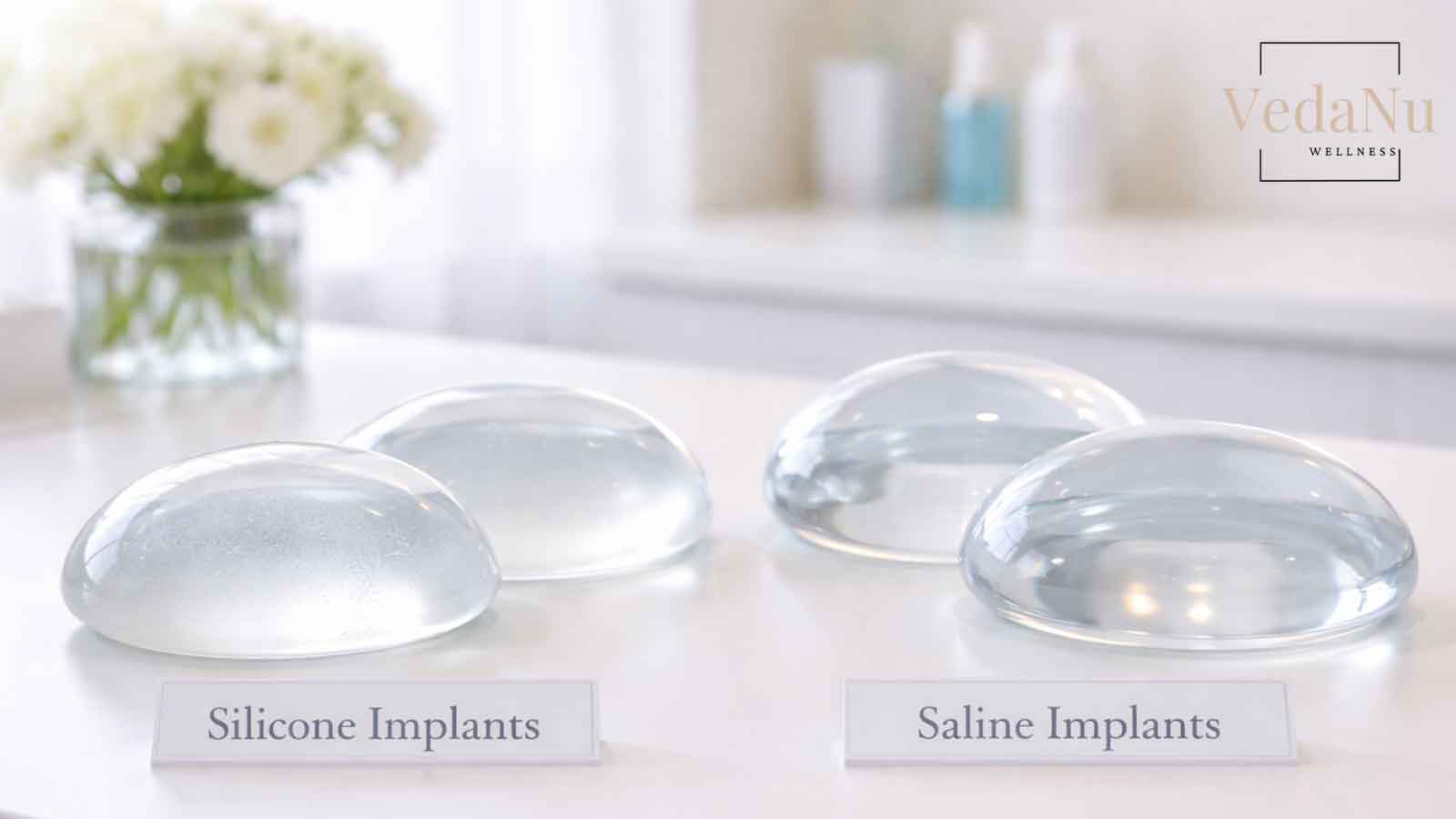
Once you’ve committed to breast augmentation, one question surfaces before all others: saline vs. silicone implants, which one is right for me? Both types are FDA-approved, widely used, and backed by decades of clinical data. The difference comes down to how each implant is built, how it looks and feels on your body, and what trade-offs matter most to you.
This guide covers the comparison across five areas: mechanics, appearance, safety, cost, and the personal factors that shape a confident decision. At VedaNu Wellness in San Diego, implant selection is never a one-size-fits-all conversation. Understanding the basics puts you in a stronger position before your first appointment.
Saline vs. Silicone at a Glance
| Saline | Silicone | |
| Fill | Sterile saltwater, filled during surgery | Pre-filled cohesive gel |
| Incision size | Smaller | Slightly larger |
| Look | Rounder, more projected | Gradual, natural slope |
| Feel | Firmer, slight liquid shift | Softer, mimics breast tissue |
| Rippling risk | Higher, especially above the muscle | Lower |
| Rupture detection | Immediate, visible deflation | Silent, requires imaging |
| FDA age minimum | 18 for cosmetic use | 22 for cosmetic use |
| Cost | Lower | Higher |
| Lifespan | 10 to 20 years | 10 to 20 years |
How Do Saline and Silicone Breast Implants Actually Differ?
Both breast implant types share a silicone outer shell. The difference lies in the fill material and in how your surgeon places each one during surgery.
Saline Implants
Your surgeon inserts a saline breast implant as an empty shell, then fills it with sterile saltwater once it is positioned inside the breast pocket. Because the shell folds flat before insertion, the required incision is smaller.
Saline also allows real-time volume adjustment. Your surgeon can calibrate the fill during surgery, which helps correct mild breast asymmetry and produces a more balanced result.
Silicone Implants
Modern silicone breast implants arrive pre-filled with cohesive gel that closely matches the weight and density of soft tissue. Today’s formulations hold their shape within the shell and carry a significantly lower risk of migration than earlier generations. Gummy bear implants, a colloquial term for highly cohesive silicone gel implants, use a firmer gel formulation that maintains its shape under pressure. Surgeons refer to them as “form-stable” since the gel maintains its intended shape within the shell, retaining its distribution if the outer surface is compromised.
Because the implant is already at its final volume, the incision needs to be slightly larger than with saline.
How They Look and Feel
For most patients, appearance and touch drive the final call. If you are researching saline vs. silicone implants, here is how the two compare. How your specific body type influences the outcome is covered in the decision section below.
Shape options differ between the two types as well. Anatomical (teardrop) implants are only available in silicone, as the form-stable gel allows the implant to maintain a tapered contour. Round implants are available in both saline and silicone. If a teardrop shape appeals to you, silicone is your only option.
- Silicone for Soft Contours & Natural Movement
Silicone produces a gradual chest contour. The upper pole (the area above the nipple) slopes softly rather than projecting sharply, creating what many patients describe as a “naturally full” look. To the touch, silicone feels softer and closer to natural breast tissue. It moves with your body during activity, and many patients find it indistinguishable from their own tissue once healing is complete. - Saline for Firmer Structure & More Projection
Saline can show visible rippling along the edges, especially above the muscle. Slight overfilling reduces that rippling but creates a rounder, more projected shape. To the touch, saline feels firmer and can produce a slight sensation of liquid shifting. The tactile difference is most noticeable in a direct comparison. On its own, many patients report strong satisfaction after full recovery.
Safety and Rupture Detection
The safety profiles of saline and silicone are comparable on paper. The practical difference is what happens if a shell fails.
- A saline rupture is immediately obvious. The implant deflates within hours as your body harmlessly absorbs the sterile saltwater, and you will notice a clear change in the affected breast’s size. No imaging is needed. Replacement requires a follow-up procedure, but the process is straightforward.
- Silicone ruptures are often called “silent” because the implant may not visibly change shape. The gel stays contained within the scar capsule, so you may not notice anything on your own.
Capsular contracture (scar tissue hardening around the implant) is a risk with both types and can occur regardless of fill material.
Implant surface texture is a related safety consideration. Textured implants carry a documented association with BIA-ALCL (breast implant-associated anaplastic large cell lymphoma), a rare but serious condition. This risk applies to both saline and silicone shells. Dr. Chao discusses surface options and their safety profiles during your consultation so you can make a fully informed choice.
Cost Considerations
The difference between the two usually ranges from a few hundred to over a thousand dollars, depending on brand and style. Saline breast implants cost less than silicone. Silicone costs more due to the complexity of its manufacturing process. Insurance does not cover cosmetic augmentation with either type.
The cost gap extends beyond the device itself. Silicone implants require periodic MRI or ultrasound screening to detect silent ruptures, and most insurance plans do not cover imaging for cosmetic augmentation patients. Over a 10- to 20-year implant lifespan, those screening costs add up. Factoring in both the upfront price and ongoing monitoring gives you a more accurate picture of total investment.
Longevity and Replacement Planning
Neither implant type is a lifetime device. Both are designed to last 10 to 20 years, and implant longevity depends on the type, your body, and how the implant responds over time. Silicone may retain its shape longer because the gel resists settling. Many patients choose to replace or upgrade at the 10- to 15-year mark, regardless of the type of device. Planning early supports long-term satisfaction and financial clarity.
How to Choose the Right Implant for Your Body & Goals

There is no single best breast implant. Here are the personal variables that tip the decision.
Your Body Type and Implant Placement
Your frame and tissue coverage play a significant role in which implant type delivers the best result.
- Thinner frame or less natural breast tissue: Silicone tends to produce a more seamless result since the gel conforms to subtle contours that a firmer fill cannot match.
- Moderate-to-full tissue coverage: You may achieve excellent results with either type, giving you more flexibility in your decision.
- Submuscular placement (under the chest muscle): Adds a layer of tissue over the implant, softening the edge transition and reducing visible rippling. This benefits both types but has the most noticeable effect on thinner frames.
- Subglandular placement (above the muscle): Provides more immediate upper-pole fullness but offers less tissue coverage over the implant edges.
Your surgeon will recommend a placement strategy based on your chest wall shape, skin elasticity, and existing breast volume. Measurements, tissue evaluation, and a physical exam provide information that online research alone cannot deliver, which is what makes an in-person assessment so valuable.
Age and FDA Guidelines
The FDA approves saline implants for cosmetic augmentation at age 18 and older. Silicone is approved starting at age 22. Both types are approved for breast reconstruction at any age.
These guidelines set a starting framework, not a ceiling. If you are under 22 and drawn to silicone, you can start with saline and transition later during a revision.
Lifestyle, Recovery, and Future Plans
Your activity level, plans for pregnancy or weight changes, and recovery timeline can all influence which type and timing make the most sense for you.
- Breastfeeding: Both implant types are compatible with lactation, though augmentation may reduce breastfeeding success for some patients. Incision type and implant placement are the primary factors: periareolar incisions carry a higher risk of disrupting milk ducts than inframammary incisions. Sharing your plans with Dr. Chao before surgery helps him select an approach that preserves function.
- Combining procedures: Some patients choose to combine augmentation with a breast lift to address both volume and position in a single procedure.
- Recovery timeline: Most patients return to light daily activities within a week and resume exercise within four to six weeks. Both implant types follow a similar recovery arc.
- Clothing and appearance: Implants are not typically visible through clothing once swelling resolves, though you will notice a change in how tops and swimwear fit.
Your surgeon takes all of these variables into account, so you leave your consultation with a clear, complete plan.
Read More: After Aesthetic Treatment: What Matters Most?
Decide What’s Best for You at VedaNu
The best way to narrow your options is a hands-on evaluation. At VedaNu Wellness in San Diego, Dr. James Chao, a board-certified plastic surgeon, walks you through implant samples, sizing, and placement so you leave with a clear plan built around your goals.
- Integrated surgical and wellness care: Breast augmentation at VedaNu is part of a full-spectrum practice that includes medical weight loss, hormone optimization, and post-op scar treatment, so your results are supported long after surgery.
- Hands-on implant selection: You will see and hold implant samples, review your options with a surgeon who specializes in breast procedures, and walk away with a plan tailored to you.
- Long-term follow-up: VedaNu monitors your implants over time with imaging guidance and scheduled check-ins, so you are never left wondering about the condition of your device.
If you’re ready to talk about your options, give us a call today.
Frequently Asked Questions About Breast Implant Types
Which breast implant looks more natural, saline or silicone?
The answer depends on your frame. Patients with adequate tissue coverage often achieve equally appealing results with either type. Your surgeon can show you both during a consultation so you can see and feel the difference firsthand.
Are silicone implants safer than saline?
Both carry comparable safety profiles. Saline ruptures are self-evident; silicone ruptures can go unnoticed without imaging. A silicone rupture is not linked to systemic diseases, but it can cause local issues such as capsular contracture, pain, or changes in breast shape. Routine monitoring helps catch silent ruptures early.
How often should one monitor implants after surgery?
The FDA recommends an MRI or ultrasound 5 to 6 years after placement, then every 2 to 3 years thereafter. If imaging does reveal a rupture, breast revision surgery addresses the issue with a planned procedure. VedaNu Wellness provides long-term monitoring guidance during your follow-up appointments, so you are never left guessing about the condition of your implants.
How much does breast implant surgery cost?
Your total procedure cost includes surgeon fees, anesthesia, facility use, and the implant, so the device itself is only one variable. VedaNu Wellness offers flexible financing so you can spread payments comfortably over time. Your care team will walk through the full pricing breakdown during your consultation.
Can you switch from saline to silicone later?
Yes. Many patients who started with saline choose to upgrade to silicone during a breast revision procedure. Your surgeon can map out that option in advance.
Does implant type affect recovery time?
The recovery arc is similar for both types. Your timeline depends more on placement technique and your body’s individual healing pace than on the fill material inside the implant.