One of the most common questions we hear during breast consultations is whether implants alone will be enough, or whether a lift should be part of the plan. It is a thoughtful question, and the answer depends on where your breast tissue sits today, not just how much fullness you want to add. When volume loss and sagging occur together, combining a breast augmentation with a breast lift in a single surgery often produces a more balanced, natural-looking result than either procedure on its own.
What a Breast Augmentation and a Breast Lift Each Do
A breast augmentation increases size and fullness using implants, while a breast lift repositions sagging breast tissue and raises the nipple to a higher, more youthful position. Understanding what each breast procedure is designed to correct makes it easier to see when combining them offers the best result, and where the two overlap in modest ways.
Breast Augmentation Restores Fullness and Projection
Implants replace lost fullness, improve projection, and rebalance proportion. At VedaNu Wellness, we offer both saline and silicone gel breast implants, each with distinct advantages in feel, appearance, and incision options.
Silicone gel implants generally provide a softer, more natural feel, while saline implants allow for smaller incisions because they are filled after placement. Cohesive gel (“gummy bear”) implants, a type of silicone implant, offer additional shape retention for selected patients. Your surgeon will recommend the implant type that best matches your anatomy, lifestyle, and aesthetic goals.
Implant profile, meaning how far the breast projects forward relative to its width, is also selected to complement your frame. Placement matters too. A submuscular implant, positioned under the chest muscle, creates a smoother upper slope and reduces visible rippling in patients with thinner tissue. Subglandular placement, over the muscle, suits women with enough natural tissue coverage and involves a shorter initial recovery.
In carefully selected patients with minimal drooping, an implant can produce a mild lifting effect. What it cannot do is raise a nipple that has dropped below the breast crease.
A Breast Lift (Mastopexy) Restores Position and Shape
Mastopexy corrects ptosis, the medical term for breast drooping. The surgery removes excess skin, tightens the remaining breast skin, and raises the breast mound higher on the chest wall; stretched areolas can be reduced during the same procedure. Overall breast volume remains similar after a lift, though the breasts often appear fuller once tissue is repositioned higher on the chest.
Bra size can sometimes decrease slightly after a standalone breast lift because removing excess skin may change how a bra fits, even though the underlying breast tissue is not significantly reduced. The actual change in cup size varies by individual and depends on factors such as how much excess skin is removed and the breast’s natural shape.
One clarification helps here. Some women have pseudoptosis, where glandular tissue sits low, but the nipple still rests above the breast crease. If that describes your anatomy, a full lift may be unnecessary, and implants alone can often restore the shape you want.
Two Procedures That Must Work Together
Augmentation stretches the breast skin to make room for an implant. A lift tightens the same skin by removing excess skin. An augmentation-mastopexy combines two procedures that must work together carefully, which is exactly why surgeon judgment matters. The amount of skin removed, the implant size and profile, and the incision pattern all must be calibrated together rather than working against each other.
Read More: Breast Lift vs. Breast Augmentation: Which Procedure Fits Your Goals?
When Does It Make Sense to Combine a Breast Lift With Implants?
The strongest candidates want two improvements at once: more fullness and a higher, more youthful position. A few situations bring patients to that point more often than others.
Volume Loss Paired With Sagging
Upper breast volume loss combined with a lower position on the chest wall is one of the most common reasons patients pursue the combined procedure. An implant placed into loose, stretched skin tends to settle low and look bottom-heavy over time, so pairing it with a lift lets the tightened tissue hold the new fullness where it belongs.
Changes After Pregnancy, Breastfeeding, or Weight Shifts
Breast implants and breast lift are typically included in a mommy makeover surgery. Pregnancy, weight fluctuations, and breastfeeding stretch the skin and deplete breast fullness at the same time, so both problems usually need to be corrected together. If you are actively losing weight, reach a stable number first, since further loss can deflate and stretch the breast again.
How Do I Know If I Need a Breast Lift With My Augmentation?
During a physical exam, surgeons look for practical cues that move the conversation toward adding a lift. You may need a breast lift with implants rather than implants alone if you notice:
- Nipple position: Your nipples sit at or below the breast crease, or point downward
- Low-sitting fullness: Most of your breast volume concentrates in the lower breast
- Reduced elasticity: Your skin has stretched to the point where it no longer maintains the shape you want
- Stretched areolas: Your areolas have widened beyond their natural proportion
- Asymmetry: One breast sits noticeably higher or projects differently than the other
At a glance:
| YOUR PRIMARY CONCERN | LIKELY BEST FIT |
| Small or deflated breasts, nipples above the crease | Augmentation alone |
| Adequate size, but sagging with nipples at or below the crease | Lift alone |
| Deflated and sagging, with a low nipple position | Combined augmentation and lift |
One or two of these cues does not automatically mean combined surgery. A physical exam confirms which column fits your anatomy, and that question deserves an answer during your consultation rather than after your augmentation heals.
Read More: The Different Types of Breast Lifts (and How to Know Which You Need)
Benefits of Combining the Surgeries
For patients who need both corrections, performing them together carries real practical advantages.
One Anesthesia Event, One Recovery Period
A combined breast augmentation and lift happens in a single surgical session: one round of anesthesia, one downtime window, and one block of time off work rather than two recoveries spaced months apart. For working parents and busy professionals, that consolidated schedule is often the deciding factor.
Shape and Volume Designed Together
Planning both procedures at once lets your surgeon set implant size, placement, and skin removal as one coordinated decision, creating a balanced contour rather than size alone. The finished silhouette pairs renewed fullness with a lifted position, in proportion with your frame.
Read More: Breast Implant Sizes Explained: How to Choose Without Regret
When a Staged Plan May Be Better
Combined surgery is technically more complex and may carry a greater likelihood of future revision compared with either procedure performed alone. Some anatomies simply do better with two operations, and a surgeon who raises this possibility is protecting your outcome, not complicating it.
Severe Ptosis or Compromised Skin Quality
When drooping is severe, maximal lifting and skin removal may be necessary before tissue can safely support an implant. Performing the lift first and adding fullness later reduces tension on healing incisions and lowers the odds of needing a breast revision.
Larger Implant Goals
A bigger implant places more stretch on freshly tightened skin. Staging the surgeries gives that skin time to settle before volume is added, which matters most when your size goal is ambitious relative to your existing tissue.
What Happens at Consultation, Surgery, and Recovery
Every combined plan starts with an honest assessment and ends with structured aftercare. Here is what the process looks like in practice.
The Consultation
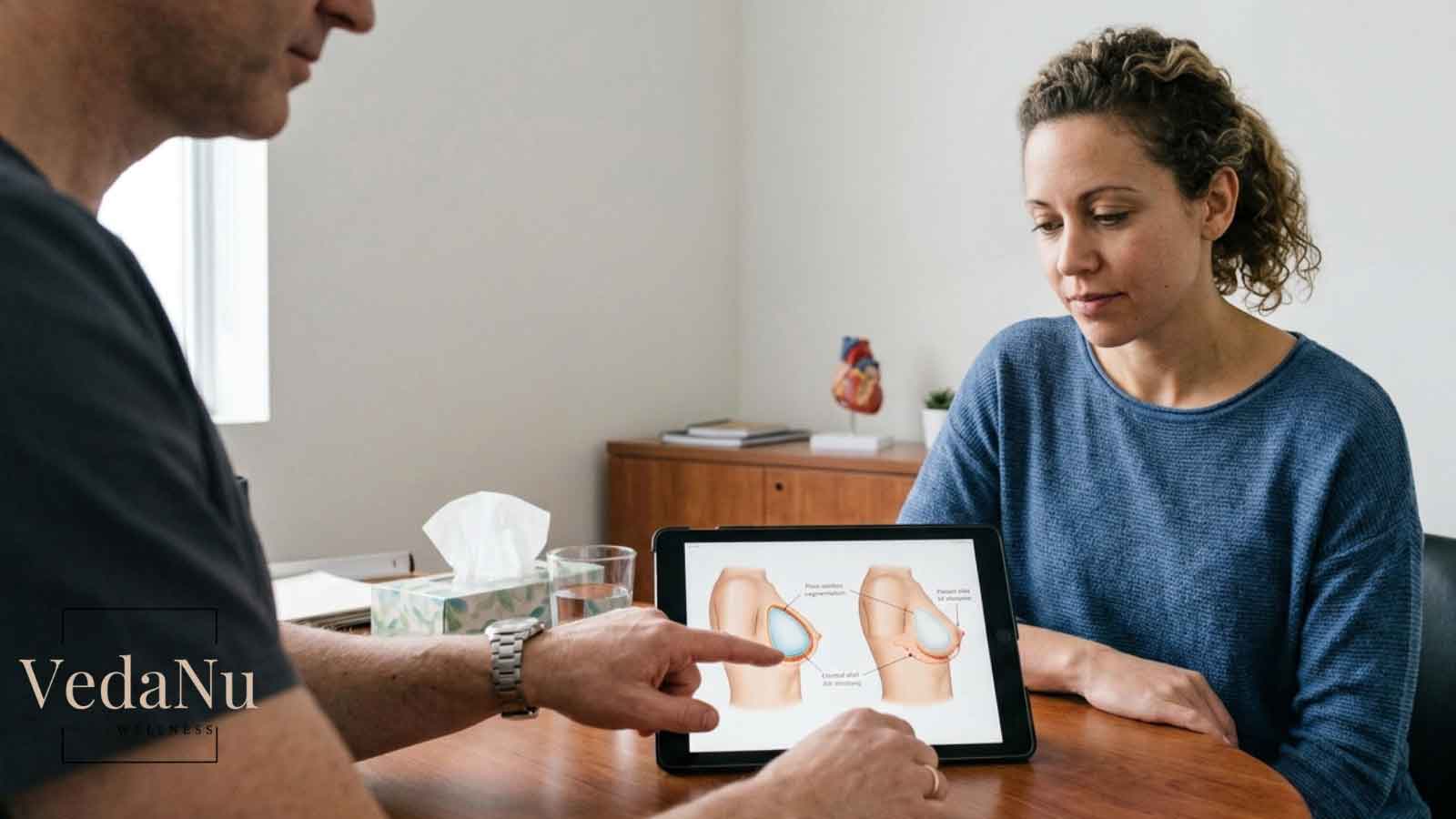
Your surgeon evaluates chest wall width, tissue quality, skin elasticity, degree of ptosis, and nipple position. In-clinic sizers and clinical photos help you visualize augmentation alone versus augmentation paired with a lift, so the decision rests on evidence rather than assumptions. Expect a frank conversation about implant considerations, the limits of what a lift can achieve, and the outcome your anatomy realistically supports.
Candidacy matters here too. Nicotine in any form impairs the skin healing a lift depends on and raises the risk of wound and nipple complications, so surgeons ask patients to quit well before and after surgery.
Implant and Incision Planning
Implant decisions cover material (saline, silicone, or cohesive gel), profile, and placement over or under the chest muscle. The lift technique is matched to your degree of ptosis:
- Periareolar (donut) lift: An incision along the areolar border, suited to mild drooping with minimal skin removal
- Vertical (lollipop) lift: An incision around the areola with a vertical extension to the breast crease, used for moderate ptosis
- Anchor (inverted-T) lift: An added incision along the breast fold, reserved for significant ptosis requiring maximal reshaping
One planning question worth raising at your consultation is how your implant placement and lift incisions will work together and what your final scar pattern will look like.
Recovery Timeline
Breast lift and augmentation recovery runs longer than either procedure alone, though healing varies by technique and by person. Plan for a longer initial rest period compared to either procedure alone, with most patients returning to sedentary work once early swelling and discomfort have stabilized.
Rest in a supportive surgical bra during the first several days and exercise phased back in over the following weeks. Contours continue to refine over the second and third months.
Scars progressively flatten and lighten over 6 to 12 months. Once healing matures, post-op scar treatments can further refine their appearance.
Restore Balance and Fullness at VedaNu Wellness
If deflation and drooping have both become part of the picture, one well-planned surgery may correct them together. Dr. James Chao, a board-certified plastic surgeon and FACS with more than 25 years of experience in plastic, reconstructive, and hand surgery, performs breast augmentation, breast lift, and combined procedures at VedaNu Wellness.
Schedule a consultation at our plastic surgery clinics in San Diego and Beverly Hills to review your anatomy, compare your procedures, explore financing options, and build a surgical plan matched to your goals.
VedaNu Wellness proudly welcomes patients from San Diego, La Jolla, Del Mar, Rancho Santa Fe, Carmel Valley, Encinitas, Carlsbad, Beverly Hills, West Hollywood, Brentwood, and surrounding Southern California communities. Contact us today to get started.
FAQs About Combining Breast Augmentation With a Lift
Can a Breast Lift and Augmentation Be Done at the Same Time?
Yes. Augmentation-mastopexy is routinely performed as a single combined operation, and the surgical plan coordinates both procedures within the same session. The operation balances two opposing actions, tightening the breast skin with the lift and stretching it with the implant, which is why candidacy and planning receive extra attention.
Is Recovery Longer When the Procedures Are Combined?
Yes, moderately. Augmentation alone allows desk work within 7 to 10 days, and combined surgery typically requires 2 to 3 weeks off work. The tradeoff still favors many patients: you heal once instead of twice.
Will a Breast Lift With Implants Change My Cup Size?
The lift reshapes and repositions your breast, and the implant sets the size. Implant selection is highly individualized and based on your anatomy, lifestyle, and aesthetic goals to achieve natural, balanced results.
How Long Do Combined Results Last?
Lift results typically last 10 or more years, though aging, pregnancy, weight fluctuations, and your natural skin quality all influence how long the shape lasts. Implants are not lifetime devices, so plan on periodic monitoring and the possibility of replacement or adjustment as your body changes.
Can I Breastfeed After Augmentation-Mastopexy?
Many patients retain the ability to breastfeed, though no breast surgery can promise it will be preserved. Certain techniques reposition the nipple in ways that may affect the milk ducts, so raise this priority during your consultation so your surgical plan can account for it.