If you’re exploring a brow lift, one question usually comes first: Would a light refresh be enough, or is a longer-term correction the better fit? That single distinction shapes everything that follows, including cost, downtime, and how much lift feels realistic for you.
Brow lift options fall into two thoughtful directions. One softly relaxes and supports the upper face with injectables. The other repositions tissue surgically for a more lasting change. Understanding which one suits your goals brings welcome clarity before you ever book an appointment.
What a Brow Lift Can Improve
A brow lift focuses on the upper third of the face, where small refinements create a noticeable shift in how awake and approachable you appear. Most patients don’t arrive asking for a lifted eyebrow by name. They describe a feeling instead.
The Concerns That Bring People In
People often point to a familiar set of changes when they begin considering this facial procedure:
- Sagging brows that rest lower than they once did, softening the eyes
- Horizontal forehead lines that linger even when your face is relaxed
- Deep-set frown lines between the brows that create a persistent appearance of tension
- A heavy, hooded feeling over the upper eyelids
- An expression that looks fatigued no matter how much rest you’ve had
These are the everyday descriptions that lead someone to start searching. Each one connects back to brow position, which is why subtly lifting this area often eases several concerns together.
Why Brows Descend in the First Place
The forehead changes for the same reasons the rest of the face does. Collagen production slows with age, skin gradually loses elasticity, and gravity steadily draws everything downward.
Repeated muscle movement settles lines into place over time, and genetics help decide how early the process begins. Sun exposure tends to move it along. This is why some people notice changes in their late 30s while others enjoy a youthful upper face well into their 50s.
How Brow Position Affects the Upper Eyelids
The brow connects the forehead and the eyes. As it descends, skin folds softly downward, and the upper lids can look weighed down, even when the lids themselves are perfectly healthy. Restoring the brow toward a more youthful position often opens the eye area and may soften forehead creases, though complementary treatments are sometimes recommended depending on your skin quality and muscle activity.
How Surgical Brow Lifts Work
A surgical brow lift renews the structure of the upper face rather than working at the surface. During the procedure, the surgeon repositions the tissues that support the eyebrow, the route most often recommended when sagging has become moderate to significant.
Repositioning Tissue, Muscle, and Skin
Surgery works on the foundation, and the details are tailored to each patient. Depending on the technique, the surgeon may adjust specific forehead muscles, remove excess skin as needed, or focus primarily on repositioning the soft tissue.
Because the correction happens at the structural level, the improvement is long-lasting. Aging continues afterward, so the brow matures naturally from its new, refreshed starting point.
Endoscopic, Traditional, and Eyelid Approach Techniques
VedaNu offers three surgical approaches, each thoughtfully matched to a different degree of descent and facial anatomy:
- Endoscopic brow lift: The least invasive of the three. Your surgeon makes a few small incisions hidden within the hairline and uses a thin camera to guide the work, with no long incision across the scalp. It suits mild to moderate descent and good skin quality, and usually offers a shorter recovery.
- Traditional (open) brow lift: Uses a longer incision placed behind or along the hairline. This allows direct access to deeper structures, the option to reduce forehead height, and the ability to remove excess skin. It’s the preferred choice for more pronounced brow descent or deeper forehead lines.
- Eyelid approach: For patients already planning upper eyelid surgery, a subtle brow elevation can be achieved through the same eyelid incision, without a separate scalp incision. This isn’t a standalone brow lift, but a way to add modest brow support during blepharoplasty.
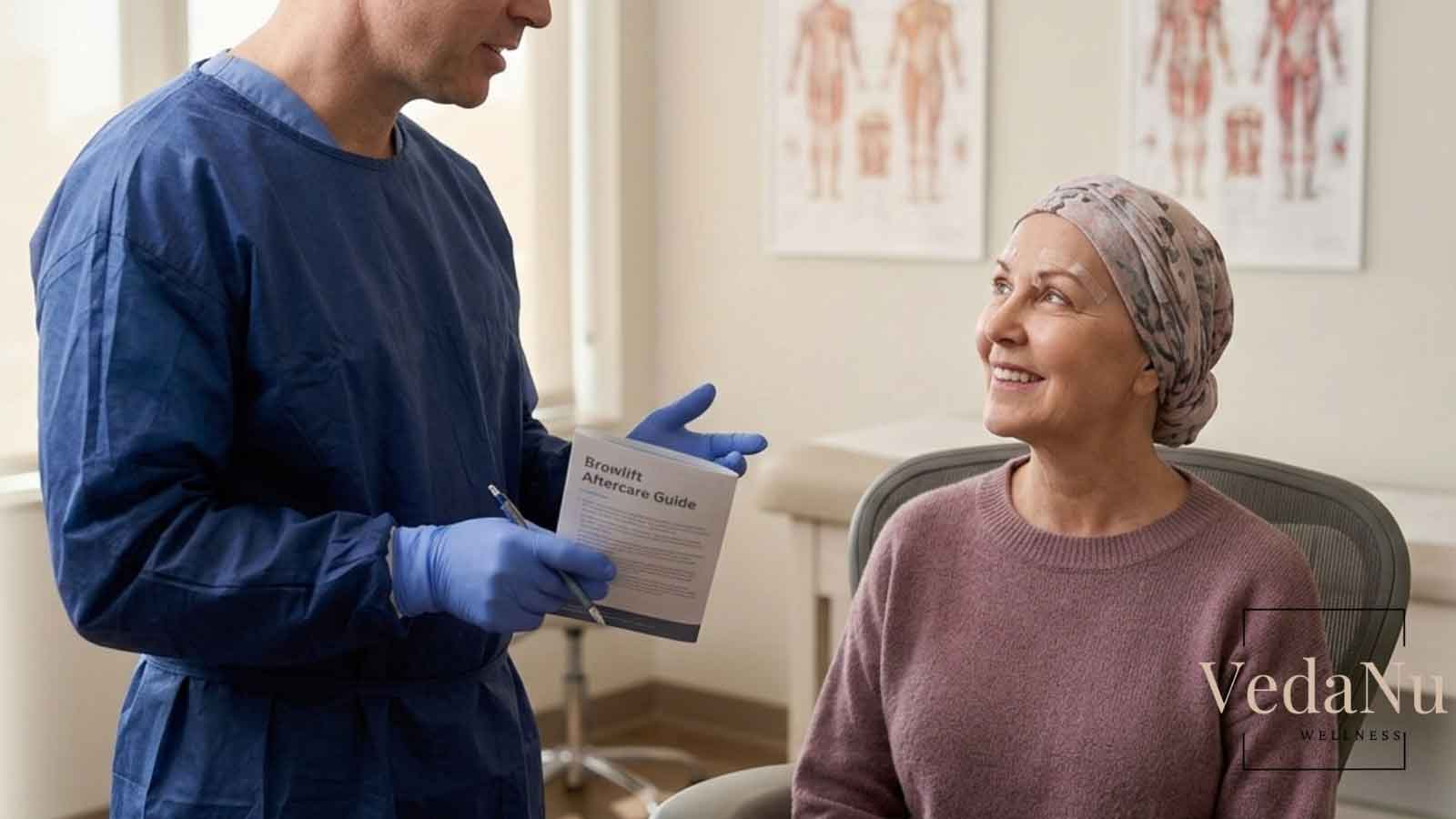
Dr. James Chao confirms the right technique during your consultation, guided by your forehead height, hairline, skin laxity, and the extent of correction your brows would benefit from.
Understanding the Risks of a Surgical Brow Lift
Like any surgical procedure, a brow lift carries some risk. Temporary swelling, bruising, tightness, or numbness near the incision sites are common in early healing, and less frequent concerns include mild asymmetry or the possibility of a minor revision procedure. Careful candidate selection and meticulous technique help keep these to a minimum, and reviewing them openly is part of caring treatment.
How Non-Surgical Brow Lifts Work
A non-surgical brow lift elevates the eyebrow without incisions, anesthesia, or meaningful downtime. Injectables do the work, subtly shifting the balance of muscles around the brow. The trade-off is duration, since these results are temporary and benefit from upkeep.
Neuromodulators That Relax the Pull
This is the part many people find surprising. Botox and Dysport don’t “freeze” the brow up. They relax the small depressor muscles that lower the brow. As those downward muscles soften, the forehead muscles can raise the brow slightly.
Our clinical team manages the non-surgical side with the same precision. Results are temporary and benefit from scheduled maintenance to sustain the lift.
Filler Support and Energy Devices
Some practices offer energy-based tightening devices for mild firming, though VedaNu focuses on injectable and surgical approaches for more predictable results.
Dermal fillers take a different route than neuromodulators. When placed at the temple or brow, fillers restore volume that gradually diminishes with age. In selected patients, that renewed support can create the appearance of a slightly more elevated brow. Filler longevity varies by product and placement, which your nurse injector will walk you through during the consultation.
The Appeal of Previewing the Look
A notable benefit of injectable brow treatment is the opportunity to evaluate the results before considering a surgical approach: you can preview a lifted brow before deciding on anything longer-lasting. A short injectable appointment shows you how a raised eyebrow suits your face, with no commitment if you feel it isn’t for you. For people in their late 20s and 30s with mild changes, that low-pressure trial is often reason enough to begin here.
Surgical vs. Non-Surgical: The Side-by-Side
Seeing the two options side by side helps bring the decision into focus:
| FACTOR | SURGICAL BROW LIFT | NON-SURGICAL BROW LIFT |
| Amount of lift | Significant, structural | Subtle, soft |
| Best suited for | Moderate to heavy sagging, deeper furrows | Mild laxity, early changes |
| Downtime | Desk work in about 10 to 14 days; settling over 6 to 12 months | Little to none |
| Anesthesia | Yes | No |
| How long results last | Long-lasting structural correction, with aging ongoing | Botox 3 to 4 months; filler varies by product |
| Upkeep | Minimal | Repeat visits welcome |
This comparison provides a reference point, though individual anatomy and goals determine the final recommendation. Two people with similar features may comfortably choose differently based on lifestyle, budget, and how much change they’re hoping for.
Which Option Fits You: Surgical Vs. Non-Surgical Brow Lift
The decision exists along a spectrum. On one end is ongoing maintenance through comfortable injectable treatments that sustain a refreshed appearance.
On the other is a single surgical procedure that corrects structural descent. Your anatomy and your readiness for recovery often point toward one approach well before your consultation.
Mild Laxity vs. Significant Descent
If your brow heaviness is early and you mostly want to look brighter, injectables often deliver enough. When the brow rests at or below the bony ridge above the eye, folds over the lids, or casts a soft shadow, that degree of change reaches beyond what a non-surgical brow lift can offer, and surgery becomes the more fitting choice.
When Upper Eyelid Heaviness Shapes the Answer
Many people describe their concern as hooded eyes rather than a low brow, and the two are closely connected. If it comes from excess eyelid skin instead, eyelid surgery may be the better option.
Who May Want to Consider Another Route
A few situations call for extra care or a different plan. Active smokers tend to heal more slowly and face higher surgical risk. Uncontrolled medical conditions are best stabilized first. People whose heaviness is mainly due to eyelid skin may be better served by blepharoplasty or eyelid surgery. And anyone hoping for an entirely new face, rather than a renewed version of their own, may find it helpful to revisit their goals beforehand.
Cost Now vs. Cost Over Time
Upfront, a non-surgical treatment costs less and requires no recovery time. Across several years, repeated injectable visits gradually add up, while a surgical result holds without ongoing spend. Many patients who want a durable change lean toward surgery, while those who value flexibility prefer injectables.
Can a Brow Lift Look Natural?
A natural-looking outcome is among the most important priorities patients raise, and it is achievable with both approaches when treatment is planned precisely. Both methods can stay beautifully subtle. Skilled injectable placement creates a soft, believable lift rather than an arched, startled look.
Surgical techniques are customizable by nature, shaped to your facial proportions rather than a one-size template. A thoughtful result restores what time has softened, so you look like a more rejuvenated version of yourself.
What Should I Ask During a Brow Lift Consultation?
A consultation at a plastic surgery clinic helps reveal which option genuinely suits you. To reach that recommendation, your surgeon considers your forehead height, brow symmetry, eyelid position, muscle activity, and overall facial proportions, and then matches the right technique to what they find. These questions are worth bringing along:
- How often do you perform this procedure?
- Given my features, which approach do you recommend, and why?
- What does recovery realistically look like for me?
- How will we keep the result looking natural?
- If any concerns arise during healing, how are they managed?
- What flexible financial options do you offer?
Dr. Chao addresses each of these during your evaluation at VedaNu Wellness.
Frequently Asked Questions — Brow Lifts
How long do brow lift results last?
A surgical brow lift typically lasts 5 to 10 years, since it renews the underlying structure. Natural aging continues, and individual results vary with skin quality and degree of correction.
Non-surgical results are temporary: neuromodulators last roughly three to four months, and filler longevity depends on the product used.
Does Botox really lift the brow, or just smooth wrinkles?
It genuinely lifts, within limits. By relaxing the muscles that draw the brow downward, Botox and Dysport allow the forehead to raise the brow slightly. The effect is real and subtle, best suited to mild heaviness rather than significant sagging.
Will a surgical brow lift leave a visible scar?
Surgeons place incisions discreetly, usually within the hairline with the endoscopic method, so scarring is typically well hidden once healed. If needed, post-op scar treatment at VedaNu Wellness is available to support continued healing.
Can men get brow lifts?
Yes, absolutely. Male brow lifts call for a different aesthetic, preserving a flatter, lower contour rather than the soft arch often suited to women, which is why technique matters as much as the decision to treat.
Am I too young for surgery?
Often, yes, and that’s perfectly fine. Younger patients often respond well to injectable treatment and can reassess their options as their anatomy changes over time.
Can I combine surgical and non-surgical approaches?
Many patients do. A surgical lift can renew the structure while injectables maintain smoothness over time. Your surgeon can map out a combined plan during your visit.
Talk Through Your Brow Lift Options at VedaNu Wellness
Choosing between a light refresh and a lasting correction feels far easier with an expert evaluating your features in person. At VedaNu Wellness, Dr. James Chao, a board-certified plastic surgeon with more than 25 years of experience and FACS distinction, helps you weigh both directions against your goals, your timeline, and your comfort with the process.
Our nurse injectors care for the non-surgical side with the same precision. We’ll help you find what feels right for you.
From our San Diego and Beverly Hills locations, we provide personalized care for patients from La Jolla, Del Mar, Rancho Santa Fe, Encinitas, Carlsbad, Bel Air, Brentwood, Santa Monica, and neighboring communities. Contact us to schedule your consultation.