A facelift is one of the most effective procedures for sagging jowls, a soft jawline, and loose neck skin. It is also one of the most misunderstood. Patients sometimes expect it to smooth their forehead, fill in hollow cheeks, or clear years of sun damage, and those concerns need entirely different treatments.
Getting that distinction right before surgery is the difference between a result that matches your expectations and one that leaves you wondering what went wrong. If you are researching a facelift in San Diego, this blog explains exactly where surgery stops and other options start. At VedaNu Wellness, Dr. James Chao, a board-certified plastic surgeon and Fellow of the American College of Surgeons (FACS) with more than 25 years of experience in plastic, reconstructive, and hand surgery, helps patients build a plan that addresses each concern with the right treatment.
What Is a Facelift Designed to Correct?
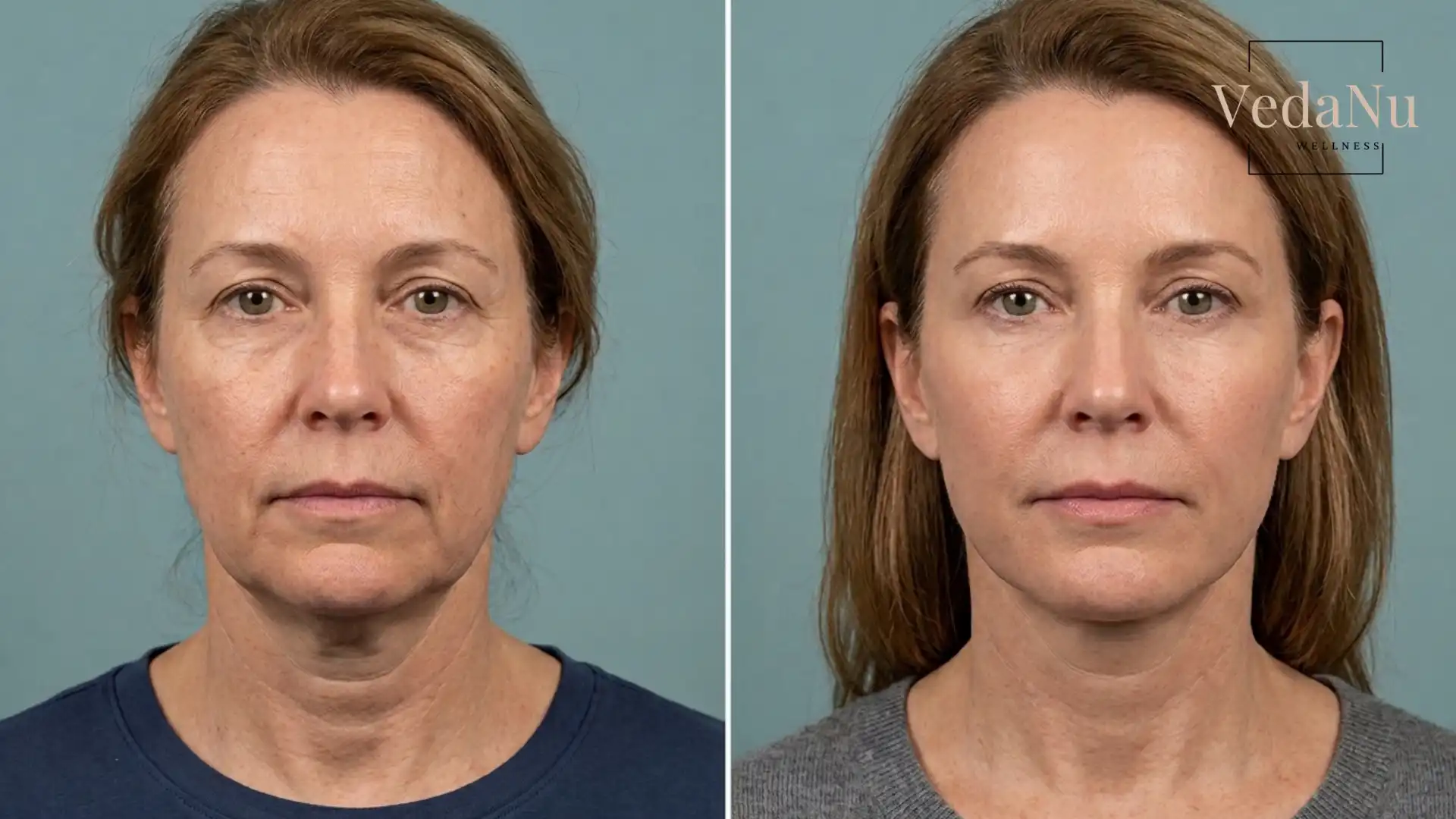
A facelift mainly addresses facial tissues that have shifted downward with age. Dr. Chao repositions deeper tissue and removes excess skin to create a firmer, more natural-looking contour.
The surgical technique depends on the areas that need correction. A deep plane facelift (a technique that works beneath the facial support layer to reposition deeper tissues) can reposition tissue through the midface and jawline, while a mini facelift uses smaller incisions to address more localized lower-face concerns.
Jowls and a Blurred Jawline
As deeper facial tissue and cheek fat move downward, they can collect along your jawline and create the heaviness you recognize as jowls.
Repositioning these tissues can give your jawline a cleaner, more defined shape and reduce heaviness through your lower cheeks. If jowls are one of your main concerns, facelift surgery may correct them more directly than many non-surgical treatments.
Folds Caused by Sagging Tissue
Nasolabial folds, which run from your nose toward your mouth, and marionette lines, which extend from the corners of your mouth toward your chin, can deepen as your cheek tissue descends.
Lifting that tissue can reduce the pressure that makes these folds look deeper. You should still expect improvement rather than complete removal, especially when deeper folds have developed over time.
Loose Neck Skin and Neck Bands
A facelift may improve loose skin near your jawline and upper neck. If you also have more noticeable neck laxity, vertical neck bands, or fullness under your chin, your surgeon may recommend combining your facelift surgery with a neck lift.
This combined approach can create a smoother transition between your lower face, jawline, and neck when more extensive correction is appropriate.
What Doesn’t a Facelift Fix, and What Can Help Instead?
Facial aging does not come from one source. Changes in tissue position, volume, skin quality, and facial movement can all affect what you see in the mirror. A facelift rhytidectomy (the medical term for a facelift) mainly addresses tissue position, so concerns caused by the other factors often need a different treatment.
A concern falling outside the scope of a facelift does not mean it cannot be treated. It means the cause may respond better to another option.
Skin Texture, Sun Damage, and Etched Lines
Changes to the surface of your skin develop independently from the deeper tissue changes a facelift corrects. Tightening deeper facial tissue does not resurface these changes.
- Rough texture, enlarged pores, and crepey skin: CO2 laser resurfacing can improve texture and stimulate collagen production (your body’s natural process of creating the protein that supports skin structure and firmness). Medical-grade skincare can also support healthier-looking skin and help maintain your results.
- Sun spots and uneven tone: Resurfacing may improve certain types of sun damage and discoloration. Daily sun protection also helps limit additional damage. Pigmentation conditions such as melasma (a condition that causes dark, blotchy patches on the skin, often triggered by sun exposure or hormonal changes) require careful evaluation because some treatments may not suit every skin type or condition.
- Fine etched lines and vertical lip lines: Resurfacing may soften lines caused by collagen loss and repeated movement. Dermal filler may also help when deeper lines involve volume loss.
Forehead Lines, Frown Lines, and Crow’s Feet
Your forehead lines, frown lines, and crow’s feet develop largely from repeated facial movement. A lower-face lift will not change how those muscles contract.
Botox® and Dysport can temporarily relax selected facial muscles and soften dynamic lines. Treatment depends on how your facial muscles move and which areas you want to address.
Hollow Cheeks, Temples, and Under-Eyes
Hollow areas develop when facial volume decreases over time. Lifting your existing tissue cannot replace the fullness you’ve lost.
- Dermal fillers: Add targeted volume to areas that appear hollow or less defined.
- Sculptra: Stimulates your body’s own collagen production and can gradually restore volume over time.
- Fat transfer: Uses your own fat to restore volume in selected areas of your face.
- Microfat grafting: Uses refined fat parcels for more delicate areas that need subtle volume restoration.
If you notice facial volume loss after significant weight loss or GLP-1 medication use, VedaNu Wellness may also recommend an Ozempic face treatment plan, which uses dermal fillers, neuromodulators, and collagen stimulators to address volume loss based on where it appears.
Heavy Brows and Hooded Eyelids
A standard facelift works mainly on the lower face, so it does not directly correct a low brow or excess eyelid skin.
A brow lift can reposition descended brows for a more refreshed appearance. Blepharoplasty can address excess upper eyelid skin or lower eyelid puffiness. In some cases, Botox® or Dysport may create a subtle brow lift without surgery.
How Can You Tell If Surgery or a Non-Surgical Option Fits Better?
The right option depends on the main cause of the change you want to address. If facial tissues have noticeably descended and you have meaningful laxity through your lower face or neck, surgery may provide more direct correction. Like any surgery, a facelift carries risks including bleeding, infection, scarring, changes in sensation, and the possibility of revision. Your surgeon will discuss these during your consultation.
Non-surgical care may make more sense when your main concerns involve skin quality, isolated volume loss, or expression lines. These concerns often respond better to treatments that target the skin, restore volume, or reduce muscle movement.
A mini facelift may sit between those options if you have earlier jowling and limited lower-face laxity. If you are researching a facelift in San Diego, the extent and location of your changes can help determine how much treatment you actually need.
How Can You Combine a Facelift With Other Treatments?
You may have more than one type of facial aging at the same time, which is why some treatment plans combine surgery with other options. The timing depends on the procedures involved and your recovery needs.
Treatments That May Be Done With Surgery
Fat transfer may be performed during the same operation to restore volume in areas that look hollow. When appropriate, resurfacing may also be considered as part of the surgical plan.
Combining procedures can affect your facelift cost because additional treatment may increase operating time, anesthesia needs, and facility fees. Your surgeon can determine which procedures are appropriate to perform together.
Treatments That May Follow Recovery
Resurfacing, Botox®, Dysport, and dermal fillers are often considered after the initial healing period. Timing matters because your face needs time to heal and swelling needs to settle before certain treatments are added.
Recovery varies from person to person, so follow the schedule your surgeon sets rather than planning additional treatment around a fixed date.
Treatments that address concerns outside the scope of your facelift may also continue to play a role in your long-term care. Daily sun protection, medical-grade skincare, and selected maintenance treatments can support your skin as it continues to age naturally.
Plan Your Facelift in San Diego With the Full Picture
Your consultation should start with the changes you want to address and the results you hope to achieve. At VedaNu Wellness, Dr. James Chao, MD, FACS, brings more than 25 years of experience in plastic, reconstructive, and hand surgery. He can help you understand which concerns a facelift in San Diego may improve and when another treatment may better address what you see. You can also review more details about techniques and recovery on our facelift procedure page.
Your treatment plan should also account for practical details. Financing is available for qualified patients, and our special offers page features current promotions. If you are traveling for surgery, our out-of-town patients page can help you prepare for appointments, transportation, and accommodations.
VedaNu Wellness also sees patients at our Beverly Hills office at 433 N Camden Dr, Suite 610, Beverly Hills, CA 90210. We serve patients from La Jolla, Del Mar, Rancho Santa Fe, Carlsbad, Encinitas, Carmel Valley, and surrounding communities.
Call 858-222-2883 or request a consultation at 8901 Activity Road, Suite 102, San Diego, CA 92126, to discuss your goals and create a personalized plan for your facelift surgery.