
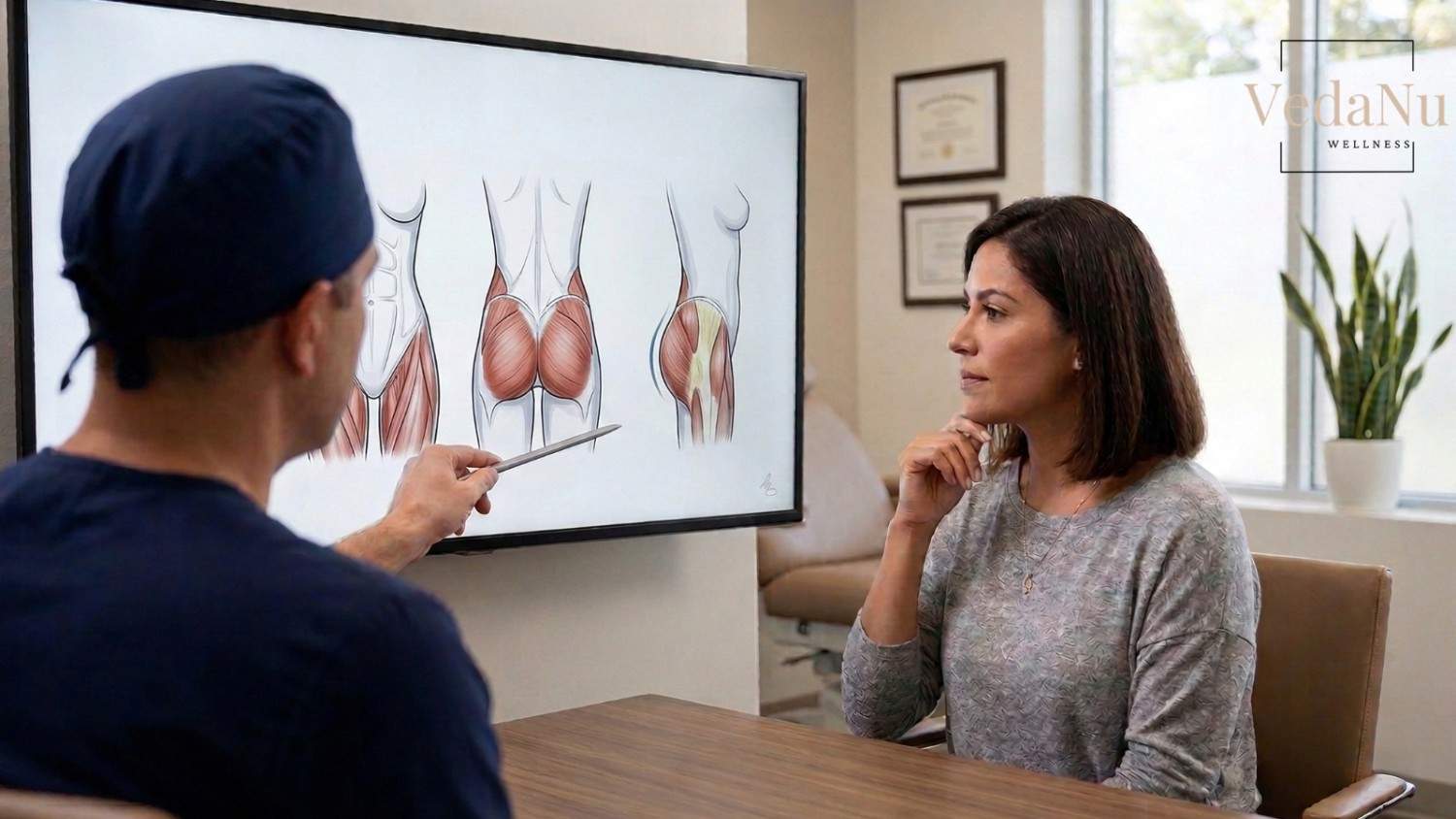
The Brazilian Butt Lift (BBL) has become one of the most requested buttock augmentation procedures because it enhances shape using your own body fat. Butt implants are another option in the broader field of buttock augmentation, though they are typically reserved for specific cases such as patients with very limited donor fat.
They work differently, suit different patients, and produce different results. The right choice depends on your body composition, aesthetic goals, and how much downtime fits your life.
This guide breaks down exactly how each procedure works, what results to expect, who qualifies, and what risks to weigh before making a decision.
BBL vs. Butt Implants: A Quick Comparison
| FACTOR | BBL | BUTT IMPLANTS |
| Natural Feel | Moves with the body | Firmer, more structured |
| Predictability | Variable, depends on fat retention | More consistent volume |
| Body Fat Required | Yes, donor sites are needed | No, ideal for lean patients |
| Durability | 5+ years with stable weight | Varies by patient and history |
| Shape Outcome | Curves, hip dip correction, hourglass | Forward projection, rounder and higher |
| Natural Integration | Uses your own fat | Foreign device in body |
Inside the Procedures: How BBL and Butt Implants Transform Shape
Before comparing results, it helps to understand what actually happens in each surgery. The techniques are fundamentally different, and that difference shapes everything from recovery to long-term outcomes.
Brazilian Butt Lift (BBL)
A Brazilian Butt Lift uses your own body fat as the augmentation material. The surgeon performs liposuction on donor areas, typically the abdomen, flanks, or thighs, to harvest fat. That fat gets purified, then carefully injected into specific layers of the buttocks to add volume and improve contour.
One of the most valued aspects of a BBL is the dual-body benefit: you slim one area while shaping another. Because no foreign materials are introduced, the augmented tissue integrates with the surrounding fat and responds to your body over time.
This approach aligns with modern body contouring principles that prioritize natural tissue integration and whole-body shaping.
Butt Implants
Butt implants involve surgically placing solid silicone devices into the buttocks. The placement plane, whether subfascial (beneath the connective tissue layer covering the muscle), intramuscular (within the gluteal muscle), or submuscular (beneath the muscle), is determined by the surgeon based on your anatomy and desired outcome. The surgeon makes incisions in the intergluteal crease (the natural fold between the buttocks), creates a pocket, and positions the implant to add pronounced projection and definition. No liposuction is involved.
This option was developed specifically for patients who lack the donor fat necessary for a BBL. It provides reliable, consistent volume independent of body fat percentage, making it an alternative for lean candidates who do not qualify for fat transfer. Butt implants and a BBL are performed under general anesthesia.
BBL vs Butt Implants Results: Shape, Projection, and Body Contour
Understanding how the results actually look is one of the most important questions you can bring to a consultation. The two body procedures produce distinctly different silhouettes.
How a BBL Shapes the Body

A BBL improves your hip-to-waist ratio by removing fat from the waist, abdomen, and flanks before transferring it to the buttocks. The result is a curvier, more hourglass silhouette rather than an isolated projection.
BBL results are also well-suited for correcting hip dips, the inward curve just below the hip bone that many patients want to soften. Fat can be precisely placed in that area to create a smoother, more continuous curve from the hip down through the thigh.
How Butt Implants Shape the Body

Butt implants maintain a defined shape and projection. The implant primarily adds volume to the upper and mid-buttocks, producing a rounder, higher appearance. For patients who are already lean with good hip structure, this focused forward projection can deliver a very sculpted result.
Implants do not address the surrounding areas. The waist, hips, and thighs remain unchanged, so the improvement in silhouette stays localized. If you are hoping for broader body contouring and a more balanced silhouette, a BBL typically delivers more comprehensive reshaping by addressing both the waist and buttocks simultaneously.
Read More: Sculpting Beauty: The Art of Face and Body Contouring
The Biggest Differences Between BBL and Butt Implants
Both procedures achieve buttock augmentation, but the experience, feel, and trade-offs differ in meaningful ways.
Which Feels More Natural?
A BBL produces results that feel like your own body, because the material is exactly that. Fat integrates with existing tissue, moves with the body during exercise and daily activity, and blends with the gluteal contour in a way that is difficult to distinguish from your natural anatomy.
Butt implants maintain a defined shape regardless of changes in the body, which many patients prefer for bold, dramatic augmentation. The trade-off is texture: implants feel firmer and can be palpable in some positions, particularly in leaner patients.
Which Results Last Longer and Stay More Consistent?
Butt implants provide consistent structural volume because the implants maintain their shape, whereas BBL results depend on fat retention during healing. Implants maintain a more consistent volume than fat transfer, though individual healing and complication history can still affect the final result. In contrast, a BBL involves a natural resorption process where the body absorbs a percentage of the transferred fat during healing.
Fat retention varies and is influenced by technique, patient healing, and activity levels, with studies reporting a wide range of outcomes. Most of this resorption occurs in the first 3 to 6 months rather than gradually over the years.
A well-retained BBL can last 5 or more years, and in many cases, much longer, provided you maintain a stable weight. Butt implants can maintain their shape for many years, though durability varies by patient and complication history.
Scarring: What Each Procedure Leaves Behind
Scarring is among the most frequently asked patient concerns, and both procedures address it in different ways.
A BBL requires small liposuction incisions at the donor sites, typically 3 to 5 millimeters in size. These are placed in natural skin folds where possible and fade significantly for most patients over 6 to 12 months. The buttock injection sites leave no visible scarring.
Butt implant surgery requires a longer incision placed in the intergluteal crease, the fold between the two buttocks. This location keeps the scar concealed in most positions and swimwear. Healing complications, such as infection or wound separation (incision separation), can cause the scar to widen, which is why following post-op scar care instructions carefully matters.
Who Is the Right Candidate for Each?
Candidacy goes beyond body composition alone. Your body type, daily habits, and occupation all factor into which procedure will serve you best.
Who Is a Good Candidate for a BBL?
You may be well-suited for a BBL if you:
- Have sufficient excess fat in donor areas such as the abdomen, thighs, or flanks
- Want to slim multiple areas of the body at the same time
- Prefer augmentation that uses your body’s own fat rather than a synthetic device
- Have maintained a consistent weight for at least 6 months and are not planning significant lifestyle changes
Patients with limited body fat are usually better suited for butt implants or hybrid augmentation. A BBL requires sufficient donor fat, so body composition directly determines eligibility. During your consultation at the plastic surgery clinic, a plastic surgeon assesses your available donor sites and helps determine the most appropriate approach for your anatomy.
Who Is a Good Candidate for Butt Implants?
Butt implants may be the better fit if you:
- Have a lean body type with limited donor fat available
- Want bold, dramatic augmentation that fat transfer cannot reliably achieve
- Seek a more consistent, predictable outcome in terms of final size
- Are comfortable with an implanted device and the associated recovery
Butt implants can produce very convincing results in the right candidate, particularly when sized appropriately for the patient’s frame. Results blend most seamlessly in patients with adequate surrounding tissue to soften the implant’s edges. Very lean patients may find the implant more apparent under certain conditions.
Lifestyle Factors That Can Influence Your Results
Your daily habits matter more than many patients initially consider. Athletes, runners, and weightlifters who return to high-intensity training quickly may experience greater fat resorption (where the body absorbs a higher percentage of the transferred fat) after a BBL if they resume strenuous activity before the transferred fat has stabilized. Committing to a conservative return-to-exercise timeline protects your results.
Patients who sit for long hours at work face a specific planning challenge after a BBL, because early recovery limits prolonged sitting. Many patients use a BBL cushion or pillow when sitting is unavoidable in the first weeks. If you drive frequently or work at a desk, this is a practical detail worth discussing at your consultation. Butt implants do not carry the same fat-survival concerns, though early sitting restrictions still apply while incisions heal.
Can You Combine a BBL and Butt Implants?
In select cases, surgeons perform a hybrid buttock augmentation that uses both techniques together. This approach suits patients who want both pronounced projection and lateral contouring but have limited donor fat that cannot fully achieve the desired size through fat transfer alone.
In a hybrid procedure, an implant provides the structural volume and forward projection, while a smaller amount of fat transfer softens the transition between the implant and surrounding tissue, fills hip dips, or improves symmetry. The result can be more comprehensive than either procedure alone for the right candidate.
This is not a standard recommendation for most patients. It carries the combined recovery demands and risk profiles of both procedures, so a thorough consultation is necessary to determine if the benefit justifies the added complexity for your specific anatomy.
What Healing Looks Like: BBL vs Butt Implants
Recovery timelines differ significantly between these two procedures and should factor directly into your decision.
BBL Recovery
After a BBL, most patients can return to light activity within 10 to 14 days. You will wear a compression garment to support healing and maintain your new contours, and your surgeon will provide specific guidance on when and how to sit safely during early recovery.
Strenuous exercise is restricted until you are cleared. Final results are typically visible after 3 to 6 months, once swelling subsides and the transferred fat fully settles.
Butt Implant Recovery
Butt implant recovery is more intensive. Full healing typically takes 3 or more months due to the incisions and muscle involvement required to place the devices.
Initial discomfort is more pronounced, and movement restrictions in the first few weeks are more limiting. Return to light activity is typically possible by weeks 3 to 4, but strenuous exercise takes considerably longer to clear.
Understanding the Risks of Each Procedure
Both BBL and butt implants are established surgical options, but each comes with its own risk profile. Both procedures can be performed safely when proper surgical technique and modern safety protocols are followed. The most important factor is working with a qualified, board-certified surgeon who selects the appropriate procedure based on your anatomy and risk profile.
BBL Risks
Early data on BBL safety identified fat embolism as a serious concern, which led to major changes in surgical technique across the field.
Modern protocols now require fat to be injected only into the subcutaneous layer, never into the gluteal muscle, where larger veins increase the risk. When performed by a board-certified surgeon trained in current subcutaneous injection techniques, the BBL has a significantly improved safety profile compared to earlier years.
Common BBL risks include:
- Fat embolism (fat entering the bloodstream)
- Fat necrosis (areas of transferred fat that do not survive and may harden)
- Asymmetry in volume or contour
- Variable fat retention that may require a touch-up procedure
- Contour irregularities at liposuction (fat removal using suction) donor sites
Butt Implant Risks
Butt implants avoid fat-related risks because no fat is injected near blood vessels. Instead, the primary concerns relate to placing a silicone implant inside the body, which carries its own surgical and long-term considerations.
Common butt implant risks include:
- Infection at the incision site
- Implant displacement or shifting
- Capsular contracture (scar tissue tightening around the implant, causing firmness or distortion)
- Implant rupture (damage to the implant shell)
- Incision separation (opening of the surgical wound)
- Seroma (fluid buildup around the implant)
- Possible implant removal or replacement over time
How BBL and Butt Implant Results Age Over Time
Both procedures are long-lasting, but neither is entirely unaffected by time and body changes.
A BBL uses living fat cells, which means your results respond to weight changes the same way the rest of your body does. Significant weight gain can cause the transferred fat to enlarge; significant weight loss can reduce volume. Maintaining a stable weight consistently produces the best long-term outcomes. The fat cells that survive the initial healing period do not dissolve or migrate on their own.
On the other hand, butt implants hold their shape regardless of weight fluctuations. The surrounding tissue ages naturally over time, regardless, and skin laxity, muscle changes, and shifts in body fat distribution can alter how the implant looks, even if the implant remains fully intact. Regular follow-ups with your surgeon help catch early signs of change before they require significant correction.
Not Sure Which Procedure Is Right? Ask Dr. Chao
While both procedures exist within the field of buttock augmentation, most patients today benefit most from a Brazilian Butt Lift because it enhances natural contours, avoids implanted devices, and reshapes the body as a whole.
The right choice ultimately depends on your anatomy, goals, and available donor fat, and that is exactly the kind of conversation Dr. James Chao at VedaNu Wellness is built for.
With over 25 years of experience in plastic and reconstructive surgery, Dr. Chao brings the technical precision and honest guidance you need to make a confident decision. Your consultation includes a thorough assessment of your anatomy and donor fat availability, a transparent conversation about realistic outcomes, and a clear discussion of costs and financing options tailored to your individual treatment plan.
If you are ready to explore your buttock augmentation options in San Diego, schedule a consultation at VedaNu Wellness. The right procedure starts with the right information.