
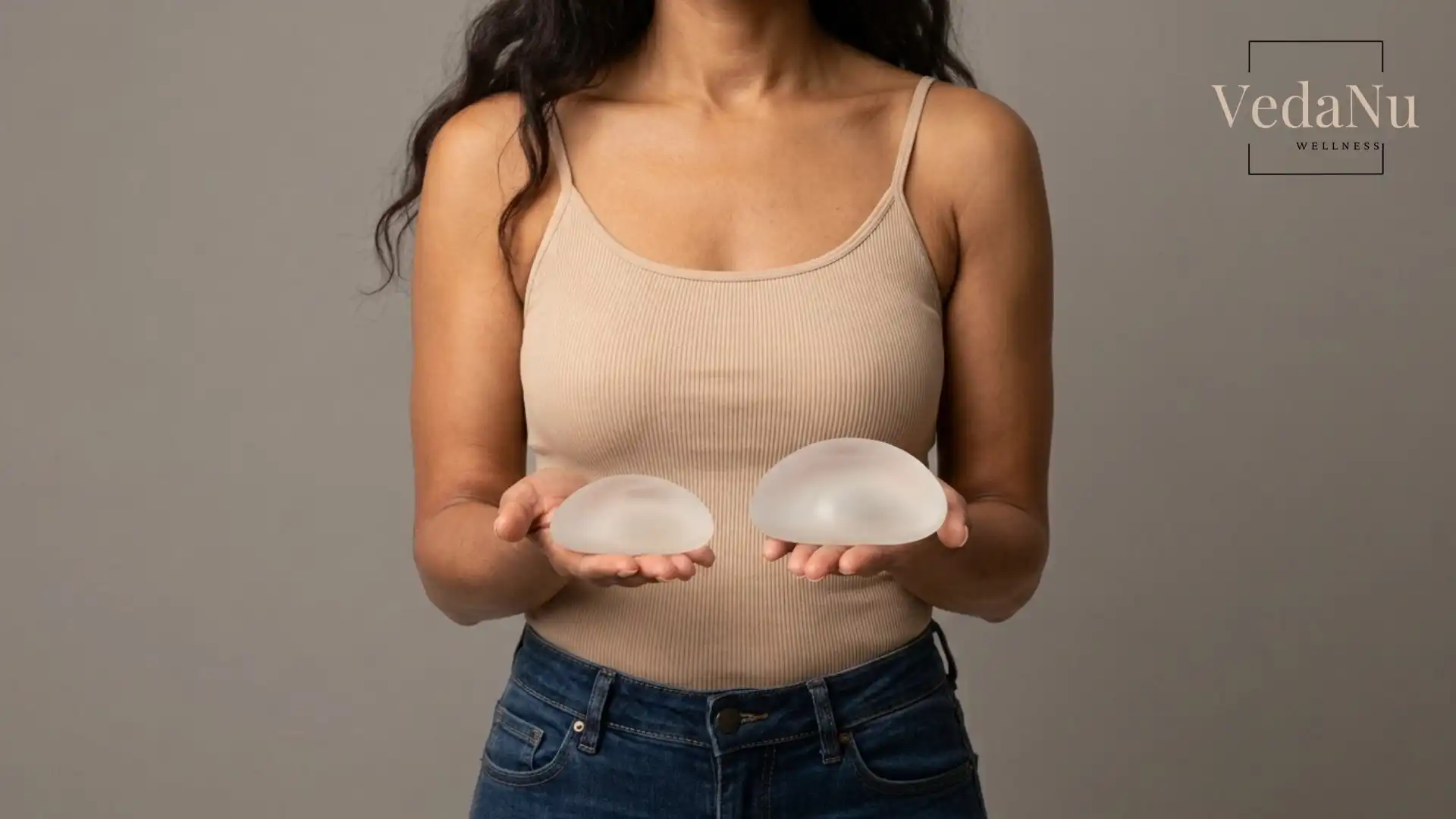
You may have a specific breast size or look in mind, especially after seeing photos of results you admire. But a size that looks great on someone else may not suit your body proportions or breast tissue.
At VedaNu Wellness, board-certified plastic surgeon Dr. James Chao plans procedures involving extra large breast implants in San Diego around your proportions and goals, with patient safety and long-term results in mind.
What Counts as an Extra Large Breast Implant?
Extra large breast implants create a noticeably fuller breast appearance. Surgeons don’t use a single measurement to define this category. Understanding how implant volume works can help you compare your options.
How Large Is an Extra Large Breast Implant?
There is no universally accepted medical definition of an extra large breast implant. The term generally describes implants intended to create a more dramatic increase in breast fullness.
Many surgeons consider implants of 800 cc and above extra large, and some reserve the term for 1,000 cc or more. That 800 cc mark is the largest standard size for prefilled silicone and saline implants sold in the United States. Dr. Chao works with silicone volumes up to 1,450 cc, and saline overfills can reach even higher volumes when your tissue can support them.
Implant size alone doesn’t determine the final appearance. The same volume can produce different results depending on the person’s body frame and existing breast shape.
Implant Volume Measured in CC, Not Cup Size
Your bra size doesn’t tell the full story. Cup sizes vary across brands, band sizes, and body frames, so surgeons use cubic centimeters (cc) to measure implant volume.
The same implant volume can look dramatic on a smaller frame but more moderate on a broader chest. This makes cc a more consistent measurement for comparing implant sizes, although it cannot predict your final cup size.
READ MORE: Breast Implant Sizes Explained: How to Choose Without Regret
How Do Surgeons Determine Which Implant Sizes Your Body Can Support?
Breast measurements help surgeons identify implant options that may suit your body. Several physical factors influence how larger implants fit, including your chest shape, skin elasticity, and existing breast tissue.
Breast Width and Chest Wall Shape
Your breast base width helps determine the implant diameter that fits your natural breast area. An implant that’s too wide may extend toward your underarms or affect your breast shape and cleavage.
The width and curve of your rib cage also affect how implants sit on your chest. Differences in chest wall shape can influence positioning and overall symmetry.
Skin Elasticity and Breast Tissue Thickness
Your skin and existing breast tissue determine how much implant volume your breasts can accommodate.
If you have thinner tissue, larger implants may create visible edges or rippling. Tight skin can also limit how much additional volume your breasts can support.
Nipple Position and Breast Sagging
Your surgeon measures the distance between your nipple and the crease beneath your breast to assess breast position and skin looseness.
These measurements help determine if added volume alone can achieve your preferred breast shape, especially when your breasts have noticeable sagging.
Natural Differences Between Your Breasts
Your breasts may differ slightly in size, shape or nipple position. These differences are common and can become more noticeable with larger implants.
Your surgeon may recommend different implant sizes or profiles to improve balance while respecting your natural anatomy.
Implant Profile and Forward Projection
Implant profile describes how far an implant extends forward from your chest. High-profile and ultra-high-profile options can provide greater projection without requiring a wider implant.
A higher profile can create a rounder, more prominent breast silhouette. Greater projection isn’t always better. The right profile depends on your breast width and how much forward projection your tissue can accommodate.
How Does Your Consultation Turn Your Goals Into an Implant Plan?
Your consultation helps connect the breast appearance you want with the surgical options available. Implant material, placement, and projection are among the choices that shape your plan.
Defining Your Desired Breast Appearance
Start by explaining what you want to change about your breasts. Consider these details:
- Fullness: How much overall volume and upper breast fullness do you want?
- Shape: Do you prefer a rounded appearance or more subtle contours?
- Proportion: How do you want your breasts to complement your shoulders, waist and hips?
- Style: Are you aiming for a natural, athletic or more dramatic look?
You can bring reference photos to show your surgeon what appeals to you. These images help communicate your preferences, although your results will depend on your anatomy.
Your surgeon can then compare your preferred look with your breast measurements and explain which implant options may help achieve it.
Trying Implant Sizers With Your Clothing
Some surgeons use physical implant sizers to help patients picture how additional breast volume might look under their clothes. These can be worn with a supportive bra and fitted top to compare proportions from different angles.
Sizers provide only an estimate. Your final appearance will depend on implant placement, existing breast tissue, and how your body heals.
Comparing Silicone and Saline Breast Implants
Your implant material also affects how your breasts may look and feel. Each option has different characteristics to consider.
- Silicone implants: Contain silicone gel designed to feel similar to breast tissue. They require ongoing monitoring because a rupture may not cause noticeable symptoms. The FDA recommends ultrasound or MRI screening beginning 5 to 6 years after surgery, then every 2 to 3 years. This screening is separate from routine follow-up care.
- Saline implants: Contain sterile saltwater and allow surgeons to adjust the fill volume within the manufacturer’s approved range. Rippling may be more noticeable than with silicone implants.
For patients considering large breast implants, saline overfilling is one way to reach volumes beyond standard implant sizes. Overfilled breast implants are saline implants filled past the manufacturer’s recommended range during surgery. This approach lets your surgeon fine-tune the volume on each side and reach sizes that prefilled implants can’t.
Overfilling has trade-offs worth discussing at your consultation. Filling beyond the manufacturer’s specifications may increase rupture risk and affect warranty coverage, and overfilled implants can feel firmer than standard fills. Long-term data on very high fill volumes remains limited, so your surgeon plans your fill around what your tissue can safely support.
If you notice breast pain, changes in shape or other unusual symptoms, contact your surgeon rather than waiting for your next scheduled screening. Continue recommended breast cancer screenings based on your age and medical history.
Choosing Implant Placement and Incision Location
Implant placement affects how your breasts look and how much natural tissue covers the implants.
Placing an implant partly beneath the chest muscle may provide additional coverage and reduce visible implant edges in some patients. This position can also cause the implant to move when your chest muscles contract. Additional muscle coverage does not eliminate the possibility of rippling.
For larger implants, your surgeon may recommend an internal bra technique. It reinforces the lower part of the implant pocket with sutures, your own tissue, or a surgical mesh, which may help hold a heavier implant in position and lower the chance of bottoming out over time.
Your implant type and size also influence incision planning. Prefilled silicone implants generally require larger incisions than saline implants, which surgeons insert empty and fill during surgery.
Your surgeon may place the incision along the crease beneath your breast to help conceal the resulting scar. Your anatomy and surgical plan determine the most appropriate incision location.
ALSO READ: Breast Augmentation Scars: Where They Go and How They Heal
Why Do Larger Breast Implants Need Long-Term Planning?
Extra-large breast implant surgery adds weight to your breast tissue, which may influence how your breasts change over time. Understanding these physical changes and possible complications can help you prepare for future care.
How Added Weight Affects Your Breasts Over Time
Large breast implants place additional weight on your skin and supporting tissues. As your body ages, you may experience:
- Skin stretching: Your skin may loosen, and your natural breast tissue may become thinner.
- Implant shifting: Implants may move below the natural breast crease or toward your underarms.
- Sensation changes: You may notice changes in nipple or breast skin sensitivity.
- Physical discomfort: Heavier implants may contribute to neck, back, or shoulder discomfort, although research on this connection remains limited.
You may also notice differences in how your breasts feel during exercise or other physical activities. Supportive bras can improve comfort, particularly during high-impact movement.
Not everyone experiences these changes. Your tissue quality, implant size, and natural aging process can influence how your breasts change over time.
What Research Says About Implant Size and Complications
A study published in Plastic and Reconstructive Surgery – Global Open examined 1,017 patients who underwent breast augmentation. Researchers found that larger implant volumes were associated with higher rates of implant rupture and breast asymmetry. They did not identify a specific volume at which complications suddenly increased.
The study examined implants with volumes up to 605 cc, so its findings cannot reliably predict the risks of extremely large implants.
Breast implants also carry general risks, including:
- Capsular contracture: Scar tissue around the implant tightens and may cause firmness, discomfort, or changes in breast shape.
- Implant rupture: The implant shell develops a tear, which may cause saline implants to deflate or silicone implants to leak without obvious symptoms.
- Implant displacement: The implant shifts from its intended position, potentially affecting breast symmetry.
- Infection: Bacteria can cause an infection around the implant, sometimes requiring additional treatment or surgery.
Other recognized risks include changes in sensation, pain and the need for further surgery. The FDA also identifies uncommon implant-associated cancers and reported systemic symptoms that patients should understand before surgery.
You can review the FDA’s breast implant risks and complications guidance for more information.
Research remains limited on extremely high implant volumes, making it difficult to predict their long-term complication rates with certainty.
Why You May Need Breast Implant Revision Later
Breast implants are not lifetime devices. You may eventually need another procedure to replace an implant, address complications, or change your breast size.
If you decide to remove your implants or downsize, stretched breast skin may not fully tighten on its own. In some cases, a breast lift can remove excess skin and reshape your breasts after the larger implants are removed or replaced.
Future revision needs vary, so it’s worth considering how your breast size preferences might change over time.
When Do You Need Staged Surgery or a Breast Lift?
Some patients may benefit from additional surgical steps to achieve their preferred breast appearance. Staged augmentation and breast lifts address different concerns, so your surgeon will assess which approach, if any, makes sense for your situation.
Staged Surgery for Larger Breast Implants
If your goal involves a significant increase in breast volume, your surgeon may consider separate procedures rather than placing the full intended volume during one operation.
In selected cases, the first procedure may involve placing a smaller implant. After your tissues heal, your surgeon can reassess their condition and determine if a larger implant is appropriate.
Staged surgery isn’t necessary for everyone considering extra large breast implants. It also doesn’t guarantee that your tissues can eventually support a particular size or eliminate the risks of larger implants.
Combining Breast Augmentation With a Lift
Larger implants add fullness, but they cannot reliably correct significant breast sagging. If your nipples sit low or your skin has lost elasticity, your surgeon may recommend a breast lift.
A lift removes excess skin and repositions breast tissue to improve your breast shape. Depending on your anatomy, your surgeon may perform the lift and augmentation together or recommend separate procedures.
RELATED ARTICLE: Combining Breast Augmentation With a Lift: When It Makes Sense
What Questions Should You Ask Before Choosing Extra Large Breast Implants?
Before committing to a larger implant size, ask questions that help you understand the possible trade-offs and long-term considerations.
- Which parts of my preferred breast appearance might be difficult to achieve with my anatomy?
- What trade-offs should I expect between implant size, projection and physical comfort?
- How might larger implants affect my options if I decide to downsize or remove them later?
- Which complications should I understand before choosing a larger implant?
- Would staged surgery or a breast lift offer any advantages in my situation?
- What follow-up examinations, implant screenings, or future procedures might I need?
Plan Your Extra Large Breast Implants in San Diego
If you’re considering extra large breast implants in San Diego, a surgical consultation can help you understand your options and the potential limitations of high-volume augmentation.
At VedaNu Wellness, Dr. James Chao, MD, FACS (Fellow of the American College of Surgeons), a board-certified plastic surgeon with over 25 years of experience, evaluates your breast augmentation goals and discusses suitable surgical approaches.
Dr. Chao specializes in extra-large breast implants, including high-volume silicone implants and saline overfills. Implant selection is highly individualized and based on your anatomy, lifestyle, and aesthetic goals. Surgery takes place at an accredited outpatient surgical facility.
Explore flexible financing options through Cherry, CareCredit, and PatientFi, along with current special offers. If you’re traveling for surgery, our out-of-town patient resources can help you prepare for your visit, recovery, and follow-up care.
We proudly serve patients in La Jolla, Del Mar, Rancho Santa Fe, Carlsbad, Encinitas, and Carmel Valley.
Schedule your consultation at our San Diego clinic at 8901 Activity Road, Suite 102, San Diego, CA 92126, or our Beverly Hills clinic at 433 N Camden Drive, Suite 610, Beverly Hills, CA 90210. You can reach our team at 858-222-2883 to start planning your procedure.