
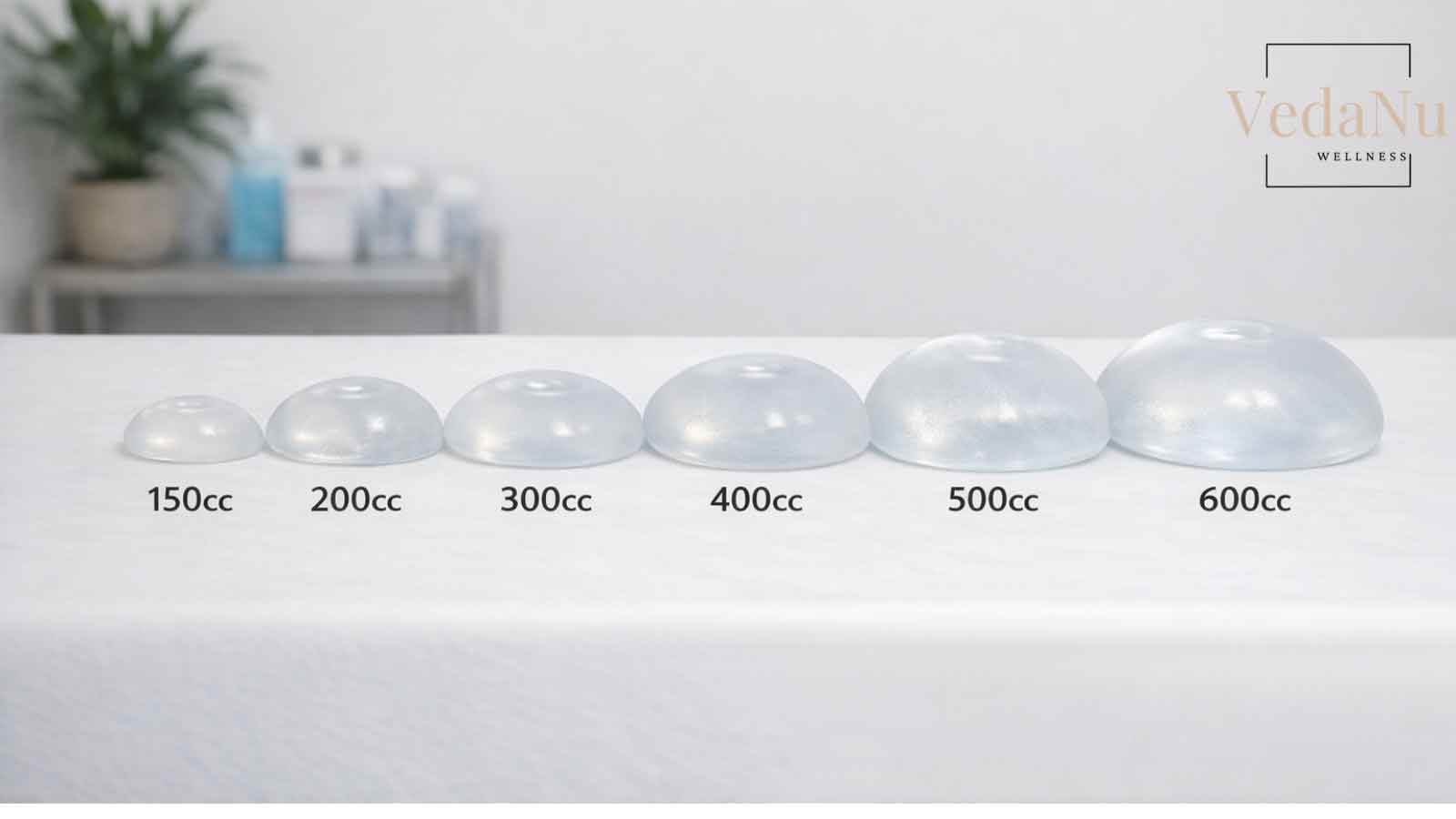
Choosing the right breast implant size is one of the most personal decisions in breast augmentation. It is natural to feel excited and a little overwhelmed at the same time. You want results that look proportional, feel comfortable, and match the vision you have for your body. The good news: implant sizing is far more precise than most people expect.
This guide breaks down how breast implant sizes work in cubic centimeters (cc), which ranges are most popular, how your body type shapes the right choice, and what steps you can take to feel confident before surgery.
How Breast Implant Sizes Are Measured
You may walk into a consultation thinking about cup sizes. That makes sense. Cup sizes are the language you use for bras every day. Implant sizing, though, works differently.
Surgeons measure implants in cubic centimeters (cc), a precise unit of volume that indicates how much space an implant occupies inside the breast pocket. Understanding these measurements gives you a shared language with your surgeon and a clearer picture of what your results will look like.
Volume, Profile & Diameter: The Three Core Measurements
Three measurements define every breast implant:
- Volume (cc): Determines overall fullness. A 150 to 200cc implant adds subtle volume; a 300 to 350cc implant falls in the mid-range most people request; and a 400cc or higher implant delivers a noticeably fuller result.
- Implant Profile: Describes how far the implant projects outward from your chest wall. Options range from low profile (wider base, less projection) to moderate profile, high profile, and extra-high profile (narrower base, more forward projection).
- Implant Diameter: Also known as base width, measures the widest point of the implant. Diameters typically range from 7.4 cm to 17.2 cm and should align with your natural chest width to prevent issues such as splaying or an unnatural gap between the breasts.
These three measurements work together. A 350cc implant with a high profile looks very different from one with a moderate profile, even at the same volume. Your surgeon balances all three based on your anatomy to create a result that looks and feels right for your frame.
How Implant Type and Shape Influence Size
The material inside your implant affects how a given cc volume looks and feels on your body.
- Silicone gel implants mimic natural breast tissue more closely and hold their shape at higher volumes, which can reduce visible rippling in thinner tissue. They come pre-filled to a fixed volume selected before surgery.
- Saline implants are filled with sterile saltwater after placement, allowing your surgeon to make minor volume adjustments during surgery. They may show more rippling if your natural tissue coverage is limited.
Implant shape plays a role, too. Round implants provide fullness across the upper and lower poles and are the most commonly used option. Anatomical implants, sometimes called teardrop implants, taper toward the top and concentrate projection at the lower pole for a more gradual slope. Your surgeon considers material, shape, and cc volume together to recommend the contour that best matches your goals.
Why Cup Sizes Are Unreliable for Implant Selection
Cup sizes vary across bra brands, countries, and even styles within the same brand. A “C cup” at one retailer may fit like a “D cup” at another. That inconsistency makes cup sizing a poor foundation for surgical planning.
Breast implant sizes in cc give your surgeon a universal, exact measurement. A 300cc implant is 300cc in every operating room in the world. When you pair that volume with the right profile and diameter for your body, you get predictable, individualized results.
Asking your surgeon for “a full C cup” may not yield the result you expect. Asking for a specific cc range based on your measurements keeps the conversation grounded in data that your surgical team can act on with precision.
Most Popular Breast Implant Size Ranges
Knowing where most people land can help you set a starting point for your own consultation. That said, popular does not mean right for everybody. Use these ranges as orientation, not prescription.
Small to Moderate Increase (125 to 300cc)
If you prefer a subtle, natural-looking change, you will likely consider implants in the 125 to 300cc range. This bracket fits petite frames and narrower chest widths well. Roughly 150 to 250cc adds about one cup size, depending on your starting breast tissue and body composition.
You can expect your results to feel like a refined version of your natural shape. The goal is proportion, not drama. A 200cc implant on a petite frame, for example, can produce a noticeably fuller silhouette that still reads as naturally yours.
Mid-Range Volume (300 to 400cc)
The 300 to 400cc range remains the most requested bracket in breast procedures nationwide, and 350cc tops the list as the single most popular implant size. You can expect a result of around a C to DD cup increase at this volume, depending on your starting anatomy.
If you want a visible change that still integrates with your body proportions, this range delivers. For average-height, average-build frames, 300 to 400cc strikes a balance that looks full in clothing and natural without it.
Large Volume Results (400cc and Above)
If you want a dramatic, head-turning result, the 400cc and above range is worth exploring. These volumes need adequate tissue coverage and a broader build to sit well over time. A wider shoulder breadth and more existing breast tissue help support larger implants without excessive strain on your skin. Specialized planning for extra-large breast implants is often necessary.
Matching Implant Size to Your Body
A breast implant size chart gives you general ranges, but your body tells the real story. Two people who both choose 350cc implants can look entirely different based on their frame, tissue, and build. The right size is the one that fits your anatomy, not the one that worked for someone else.
Frame, Chest Measurements, and Implant Placement
Your surgeon starts with hard numbers: chest width, shoulder breadth, height, and tissue thickness. These measurements determine which implant diameter fits your frame and how much volume your tissue can comfortably support.
- Narrow chest and petite build: You will typically pair best with smaller diameters (under 12 cm) and moderate volumes. Going too wide or too heavy can create an unbalanced look or increase the chance of rippling.
- Taller or broader build: You have room for wider diameters and higher volumes. Your chest wall provides a larger canvas, and your tissue offers more natural coverage over the implant.
Where your surgeon places the implant affects perceived size, too. An implant placed under the chest muscle (submuscular placement) tends to appear slightly smaller and more gradual, as the muscle compresses the upper pole. An implant placed above the muscle (subglandular placement) typically displays more immediate fullness and upper pole projection.
Tissue Limits and Implant Weight
Your skin and breast tissue can only accommodate so much volume before structural issues develop. Exceeding your tissue capacity increases the risk of bottoming out (where the implant drops below the natural breast fold), visible rippling, double bubble deformity, and accelerated sagging over time. If you have thinner tissue, these risks emerge at lower cc volumes than they would for someone with denser, more elastic coverage.
Implant weight is another practical factor. One cc of silicone or saline weighs roughly 1 gram, so a 400 cc implant adds about 400 grams (just under a pound) per breast. At higher volumes, that weight exerts a constant downward force on your tissue and can stretch it, particularly if your skin is less elastic.
Lifestyle and Long-Term Factors
Your daily routine matters more than you might realize. These factors shape which implant size will serve you best over time.
- Activity level: If you run, do CrossFit, or play sports, you may prefer a moderate-profile implant that sits close to your chest wall and reduces bounce during movement. A high-profile implant in the same scenario can feel heavier during intense activity.
- Recovery timeline: Recovery is more closely tied to implant placement and tissue stretch than to raw cc numbers alone. A larger implant in a submuscular pocket, for instance, may require a longer initial recovery period than a smaller implant placed above the muscle.
- Pregnancy plans: If you plan to have children, your breast tissue will change during and after pregnancy, and your implant placement can shift as your body adjusts. Sharing those plans with your surgeon helps you choose a size that accommodates future changes.
- Weight fluctuations: Gaining or losing 15 to 20 pounds can alter how your implants sit and how your natural tissue drapes around them. Choosing a size that accounts for your full weight range gives you results that hold up through normal body changes.
- Age-related skin changes: Younger patients with firm tissue can often support a wider range of volumes. If you are in your 40s or older, thinner skin and reduced elasticity may limit how much volume your tissue can hold before it begins to sag. Your surgeon considers your skin quality today and how it may change over the next decade.
If tissue laxity is a concern alongside volume, you may want to explore how a breast lift can complement your augmentation.
How to Avoid Sizing Regret
Sizing dissatisfaction is one of the most common reasons people seek breast revision surgery. The implants end up feeling too large, too small, or mismatched to the frame.
A revision adds surgical fees, additional recovery time, and a second round of surgical risk on top of your original procedure. These steps help you preview your results with clarity and make a confident choice the first time.
Test With Sizers During Your Consultation
Implant sizers are physical samples that your surgeon places inside a bra during your appointment. You see and feel how different volumes sit on your body in real time. Try them under a fitted top, a workout tank, and a dress or blouse you would typically wear.
Sizers eliminate the guesswork of visualizing cc numbers. You experience the volume on your own frame, in your own clothing, before you commit to a single number.
Review Before-and-After Photos on Similar Body Types
Before-and-after photos are most helpful when they feature people with a similar height, weight, and starting breast tissue to yours. Ask your surgeon to pull cases that match your build so you can see how a given cc range actually looks on a frame like yours.
VedaNu Wellness maintains a gallery of real patient results. Reviewing these images grounds your expectations in actual outcomes rather than filtered social media posts.
Prioritize Your Surgeon’s Guidance Over Trends
Social media trends shift every few years. The “right” look on Instagram today may feel overdone to you in five years. A board-certified plastic surgeon accounts for variables that no influencer or online breast implant size chart can measure, including how your anatomy will interact with an implant over the long term.
Every patient falls somewhere on the spectrum between subtle refinement and bold augmentation, and neither end is wrong. What matters is that your choice reflects your personal aesthetic, not pressure from outside sources. Many surgeons approach sizing as an aesthetic strategy, working with you to define the look you want and then matching the right implant specifications to achieve it. That approach keeps your results personal and timeless, never trend-driven or temporary.
Read More: After Aesthetic Treatment: What Matters Most?
Your Breast Implant Sizing Consultation at VedaNu Wellness
Finding your ideal breast implant size comes down to one step: a thorough consultation with a surgeon who takes the time to understand your body and your vision for it.
Your sizing consultation at our plastic surgery clinic in San Diego includes:
- Detailed body mapping: Your chest width, tissue thickness, shoulder breadth, and breast dimensions are documented down to the centimeter
- Sizer trials: Hands-on testing with physical implant samples in a private fitting environment
- Collaborative goal-setting: A candid conversation about the look you want, the activities you do, and the long-term results that matter most to you
Your consultation provides measurable data, visual previews, and hands-on comparisons before you commit. Every recommendation is backed by our decades of surgical experience.
Ready to find your ideal breast implant size? Schedule your consultation at VedaNu Wellness and start your breast augmentation journey with confidence.